
Haskell vs JavaScript
Haskell
The beautifully dressed philosopher who can't find their car keys. Haskell writes the most elegant code in any language, then spends 45 minutes explaining why IO is actually a monad.
JavaScript
The accidental emperor who conquered the world in 10 days. JavaScript was built as a toy, became the backbone of the internet, and still thinks '0' == 0 is reasonable.
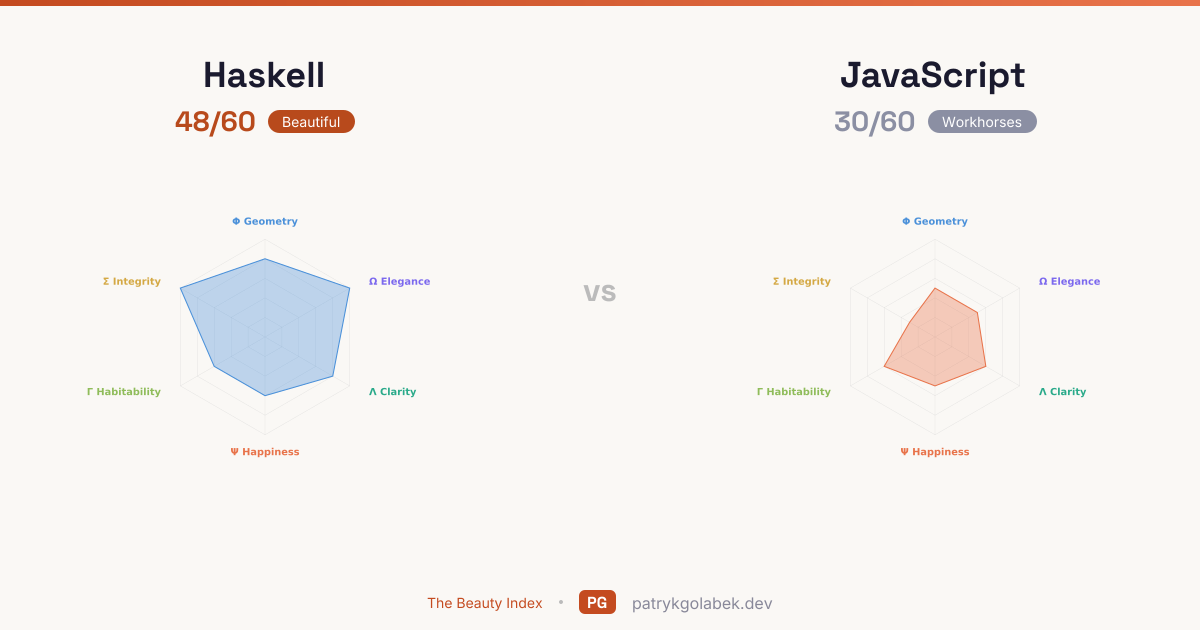
Haskell scores 48/60 against JavaScript's 30/60, leading in 5 of 6 dimensions. Haskell dominates the aesthetic, mathematical, human, and design axes. Conceptual Integrity is where the pair separates most cleanly — Haskell leads JavaScript by 7 points and that gap colours everything else on the page.
See also: Haskell vs Clojure , Haskell .
Dimension-by-dimension analysis
Σ Conceptual Integrity
Haskell wins Conceptual Integrity by 7 points — a clear integrity advantage. "Avoid success at all costs." Haskell is about something: purity, types, and mathematical foundations. Every feature follows from a coherent worldview. It's the most internally consistent language design on this list. The design philosophy of Haskell feels inevitable, each feature a consequence of one idea — JavaScript feels assembled from several good ideas instead of from one great one. Famously designed in 10 days with no unified vision. Decades of backward-compatible additions have layered prototypal OOP, functional patterns, class syntax, modules, and async models on top of each other. JavaScript is the archetypal "accumulated rather than designed" language. The winner's philosophical discipline is what keeps its idioms stable as the language evolves.
Ω Mathematical Elegance
Haskell wins Mathematical Elegance by 5 points — a genuine expressive lead. The gold standard. fibs = 0 : 1 : zipWith (+) fibs (tail fibs) defines infinity by self-reference. Purity, lazy evaluation, and higher-kinded types let algorithms approach Erdős's "Book" proofs. No other language comes close. The gap on Elegance is real: Haskell rewards precise thought, JavaScript rewards precise bookkeeping. First-class functions, closures, and prototype chains enable some elegant patterns. Array methods (.map, .reduce, .filter) are expressive. But the language provides too many ways to do everything, and none feel mathematically inevitable. The winner lets the author think in algorithms rather than in ceremony.
Φ Aesthetic Geometry
Haskell wins Aesthetic Geometry by 3 points — a clear geometric edge. Clean Haskell is visually striking, where clauses, pattern matching, and type signatures create a structured, proportional layout. Docked from 9 because production Haskell with GADTs and monad transformer stacks can produce dense type-signature walls. JavaScript, by contrast, accepts visual density in exchange for other priorities. JavaScript's visual style depends entirely on the developer and framework. The language itself imposes no visual discipline. Curly braces, callbacks, and framework-specific patterns create inconsistent visual texture across codebases. In a language where expressiveness is the selling point, visual calm amplifies the advantage.
Λ Linguistic Clarity
Haskell wins Linguistic Clarity by 2 points — a clear signal-to-noise edge. Simple Haskell reads like mathematics rendered in prose. Point-free style and function composition create elegant chains of meaning. Docked from 9 because lens operators (^., .~) and advanced type-level code can be opaque even to intermediate Haskellers. Where Haskell favours plain intent, JavaScript trades clarity for control, capability, or history. Modern JavaScript (ES6+) reads reasonably well — arrow functions, destructuring, and template literals improve clarity. Docked because typeof null === 'object', implicit coercion, and this binding make code that looks clear but behaves surprisingly. For application code the clarity advantage is the whole point of the language category.
Ψ Practitioner Happiness
Haskell edges JavaScript by a single point on Practitioner Happiness; the practical difference is slim but real. Moderate Stack Overflow admiration (~57%), well below Rust, Elixir, or Gleam. The learning curve is brutal, Cabal/Stack tooling fragmentation has caused years of pain, and cryptic error messages for type-level code create real frustration. The community is passionate but small. Developers admire Haskell more than they enjoy it day-to-day. Both Haskell and JavaScript are broadly loved; Haskell is loved a little harder, a little more loudly. JavaScript is everywhere, and many developers use it because they must, not because they love it. The ecosystem's churn (framework fatigue) creates constant friction. Individual tools (React, Node) are liked; the language itself gets mixed reviews. The winner here invites the next generation of contributors without asking them to earn it first.
Γ Organic Habitability
Both score 6 — this is one dimension where Haskell and JavaScript genuinely agree. Purity is a double-edged sword, you can't "just add a side effect here" without restructuring. Changing one type signature can cascade through an entire module. Haskell code is correct but often brittle to modify, which is the opposite of Gabriel's habitability ideal. Both Haskell and JavaScript have proven they can carry code across decades — this is not where they differ. JavaScript's flexibility means codebases can be extended organically. The ecosystem's dynamism keeps things evolving. But the same flexibility produces wildly inconsistent patterns, and the lack of guardrails makes long-term maintenance unpredictable. The winner here is the language you will still enjoy reading in five years.
Code comparison
For/while iteration patterns and loop constructs.
-- Haskell uses recursion, not loopsfactorial :: Integer -> Integerfactorial 0 = 1factorial n = n * factorial (n - 1)
evens :: [Int] -> [Int]evens xs = [x | x <- xs, even x]for (const item of items) { console.log(item);}
items.forEach((item, index) => { console.log(`${index}: ${item}`);});
for (let i = 0; i < 10; i++) { console.log(i);}The characteristic code snippet that best represents each language.
quicksort :: Ord a => [a] -> [a]quicksort [] = []quicksort (x:xs) = quicksort smaller ++ [x] ++ quicksort bigger where smaller = [a | a <- xs, a <= x] bigger = [a | a <- xs, a > x]async function fetchUserPosts(userId) { const [user, posts] = await Promise.all([ fetch(`/api/users/${userId}`).then(r => r.json()), fetch(`/api/users/${userId}/posts`).then(r => r.json()), ]);
const { name, avatar } = user; return { name, avatar, posts: posts.slice(0, 5) };}Data structure definition using classes, structs, records, or equivalent.
data User = User  { userName  :: String  , userEmail :: String  , userAge   :: Int  } deriving (Show, Eq)
data Shape = Circle Double | Rectangle Double Doubleclass User { constructor(name, email, age = 0) { this.name = name; this.email = email; this.age = age; }
greeting() { return `Hello, ${this.name}!`; }}Frequently asked questions
- Which is easier to learn, Haskell or JavaScript?
- Haskell scores 6 on Practitioner Happiness versus JavaScript's 5. Moderate Stack Overflow admiration (~57%), well below Rust, Elixir, or Gleam. The learning curve is brutal, Cabal/Stack tooling fragmentation has caused years of pain, and cryptic error messages for type-level code create real frustration. The community is passionate but small. Developers admire Haskell more than they enjoy it day-to-day. For a newcomer picking up their first serious language in 2026, the happiness-score winner is the more forgiving starting point.
- Is Haskell or JavaScript better for principled design?
- For principled design, Haskell has a clear edge — it scores 10/10 on Conceptual Integrity against JavaScript's 3/10. "Avoid success at all costs." Haskell is about something: purity, types, and mathematical foundations. Every feature follows from a coherent worldview. It's the most internally consistent language design on this list.
- Should I pick Haskell or JavaScript in 2026?
- Haskell lands in the beautiful tier at 48/60; JavaScript in the workhorses tier at 30/60. With this much daylight between them, the higher scorer is the default and the lower scorer needs a business case. The score difference reflects years of community use, tooling maturity, and the editorial judgment of the Beauty Index rubric.