
Haskell vs Java
Haskell
The beautifully dressed philosopher who can't find their car keys. Haskell writes the most elegant code in any language, then spends 45 minutes explaining why IO is actually a monad.
Java
The enterprise middle manager who requires a meeting to schedule a meeting. Java turned verbosity into a virtue and AbstractSingletonProxyFactoryBean into a punchline.
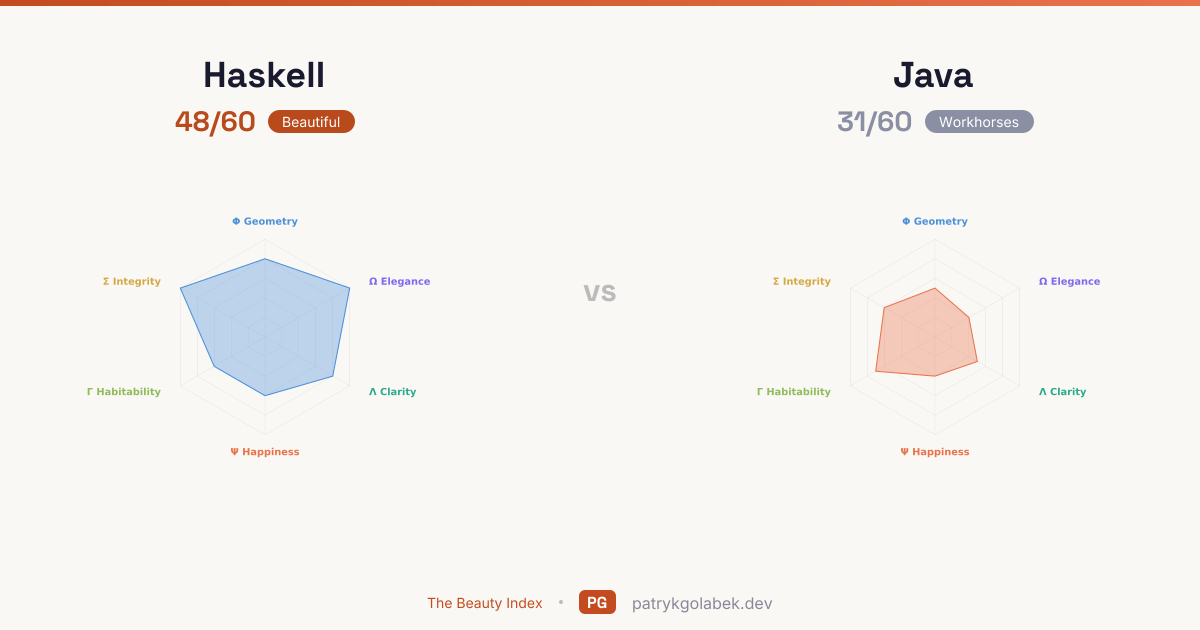
Haskell scores 48/60 against Java's 31/60, leading in 5 of 6 dimensions. Haskell dominates the aesthetic, mathematical, human, and design axes. The pair splits practitioner joy from long-term habitability — Haskell wins the week, Java wins the decade.
See also: Haskell vs Clojure , Haskell .
Dimension-by-dimension analysis
Ω Mathematical Elegance
Haskell wins Mathematical Elegance by 6 points — a decisive elegance advantage. The gold standard. fibs = 0 : 1 : zipWith (+) fibs (tail fibs) defines infinity by self-reference. Purity, lazy evaluation, and higher-kinded types let algorithms approach Erdős's "Book" proofs. No other language comes close. The gap on Elegance is real: Haskell rewards precise thought, Java rewards precise bookkeeping. Java's OOP-first design resists mathematical abstraction. Expressing algorithms requires ceremony, AbstractFactory, Iterator, Consumer<T>. The patterns are powerful but the opposite of Hardy's "economy." For high-level work, the gap compounds: fewer lines per algorithm means fewer bugs per feature.
Σ Conceptual Integrity
Haskell wins Conceptual Integrity by 4 points — a decisive philosophical edge. "Avoid success at all costs." Haskell is about something: purity, types, and mathematical foundations. Every feature follows from a coherent worldview. It's the most internally consistent language design on this list. Haskell speaks with a single design voice; Java speaks with a committee. "Write once, run anywhere" was a clear mission, and the JVM delivered. But decades of committee-driven feature additions (generics via erasure, streams, modules, records) have layered paradigms without fully integrating them. Coherent enough, not focused. In high-level work a coherent philosophy is the frame that holds the language's features together.
Λ Linguistic Clarity
Haskell wins Linguistic Clarity by 3 points — a meaningful clarity gap. Simple Haskell reads like mathematics rendered in prose. Point-free style and function composition create elegant chains of meaning. Docked from 9 because lens operators (^., .~) and advanced type-level code can be opaque even to intermediate Haskellers. Where Haskell favours plain intent, Java trades clarity for control, capability, or history. Java communicates intent through names and types, but the signal is buried under ceremony. AbstractSingletonProxyFactoryBean communicates structure but not wit. Java code is precise, but reading it is work. The winner here treats readability as a core feature rather than a style preference.
Φ Aesthetic Geometry
Haskell wins Aesthetic Geometry by 3 points — a decisive visual advantage. Clean Haskell is visually striking, where clauses, pattern matching, and type signatures create a structured, proportional layout. Docked from 9 because production Haskell with GADTs and monad transformer stacks can produce dense type-signature walls. The visual gap between the two is not subtle — where Haskell prizes geometric calm, Java trades that serenity for other commitments. Java code is visually heavy, class wrappers, access modifiers, type declarations, and boilerplate create dense blocks. Modern Java (records, sealed classes) helps, but the language's verbosity is structural, not stylistic. For application code the geometry translates directly into readability for new contributors.
Ψ Practitioner Happiness
Haskell wins Practitioner Happiness by 2 points — a real happiness advantage. Moderate Stack Overflow admiration (~57%), well below Rust, Elixir, or Gleam. The learning curve is brutal, Cabal/Stack tooling fragmentation has caused years of pain, and cryptic error messages for type-level code create real frustration. The community is passionate but small. Developers admire Haskell more than they enjoy it day-to-day. The practitioner experience on Haskell is simply more fun, day in and day out, than on Java. Widely used, rarely loved. Stack Overflow admiration is moderate. The ecosystem is massive and mature, but developer experience surveys consistently place Java in the "tolerated" category. The JVM is respected; the language syntax is endured. For high-level work, developer happiness is the main driver of long-term retention.
Γ Organic Habitability
Java edges Haskell by a single point on Organic Habitability; the practical difference is slim but real. Java's greatest strength: codebases survive decades. Backward compatibility is nearly absolute. Enterprise patterns, for all their verbosity, create predictable structures that large teams can maintain. Java is habitable in the way a well-run office building is habitable. Both Haskell and Java age reasonably well; Java is merely a little kinder to the future reader. Purity is a double-edged sword, you can't "just add a side effect here" without restructuring. Changing one type signature can cascade through an entire module. Haskell code is correct but often brittle to modify, which is the opposite of Gabriel's habitability ideal. The winner here is the language you will still enjoy reading in five years.
Code comparison
Conditional branching and control flow expressions.
classify :: Int -> Stringclassify n | n < 0 = "negative" | n == 0 = "zero" | n < 100 = "small" | otherwise = "large"String label;if (score >= 90) { label = "excellent";} else if (score >= 70) { label = "good";} else if (score >= 50) { label = "average";} else { label = "needs improvement";}For/while iteration patterns and loop constructs.
-- Haskell uses recursion, not loopsfactorial :: Integer -> Integerfactorial 0 = 1factorial n = n * factorial (n - 1)
evens :: [Int] -> [Int]evens xs = [x | x <- xs, even x]for (var item : items) { System.out.println(item);}
for (int i = 0; i < 10; i++) { System.out.println(i);}
int sum = 0;while (sum < 100) { sum += 10; }The characteristic code snippet that best represents each language.
quicksort :: Ord a => [a] -> [a]quicksort [] = []quicksort (x:xs) = quicksort smaller ++ [x] ++ quicksort bigger where smaller = [a | a <- xs, a <= x] bigger = [a | a <- xs, a > x]Map<String, Long> wordFrequency = Files.lines(Path.of("book.txt")) .flatMap(line -> Arrays.stream(line.split("\\s+"))) .map(String::toLowerCase) .filter(w -> w.length() > 3) .collect(Collectors.groupingBy( Function.identity(), Collectors.counting() ));Frequently asked questions
- Which is easier to learn, Haskell or Java?
- Haskell scores 6 on Practitioner Happiness versus Java's 4. Moderate Stack Overflow admiration (~57%), well below Rust, Elixir, or Gleam. The learning curve is brutal, Cabal/Stack tooling fragmentation has caused years of pain, and cryptic error messages for type-level code create real frustration. The community is passionate but small. Developers admire Haskell more than they enjoy it day-to-day. For a developer adding a new language to their toolbelt, the happier one is the one you will still be writing in.
- Is Haskell or Java better for algorithm-heavy code?
- For algorithm-heavy code, Haskell has a clear edge — it scores 10/10 on Mathematical Elegance against Java's 4/10. The gold standard. fibs = 0 : 1 : zipWith (+) fibs (tail fibs) defines infinity by self-reference. Purity, lazy evaluation, and higher-kinded types let algorithms approach Erdős's "Book" proofs. No other language comes close.
- Should I pick Haskell or Java in 2026?
- Haskell lands in the beautiful tier at 48/60; Java in the workhorses tier at 31/60. With this much daylight between them, the higher scorer is the default and the lower scorer needs a business case. The score difference reflects years of community use, tooling maturity, and the editorial judgment of the Beauty Index rubric.