
Haskell vs Elixir
Haskell
The beautifully dressed philosopher who can't find their car keys. Haskell writes the most elegant code in any language, then spends 45 minutes explaining why IO is actually a monad.
Elixir
The jazz musician who studied classical. Elixir takes Erlang's battle-tested concurrency and wraps it in syntax so pleasant you forget you're building distributed systems that never go down.
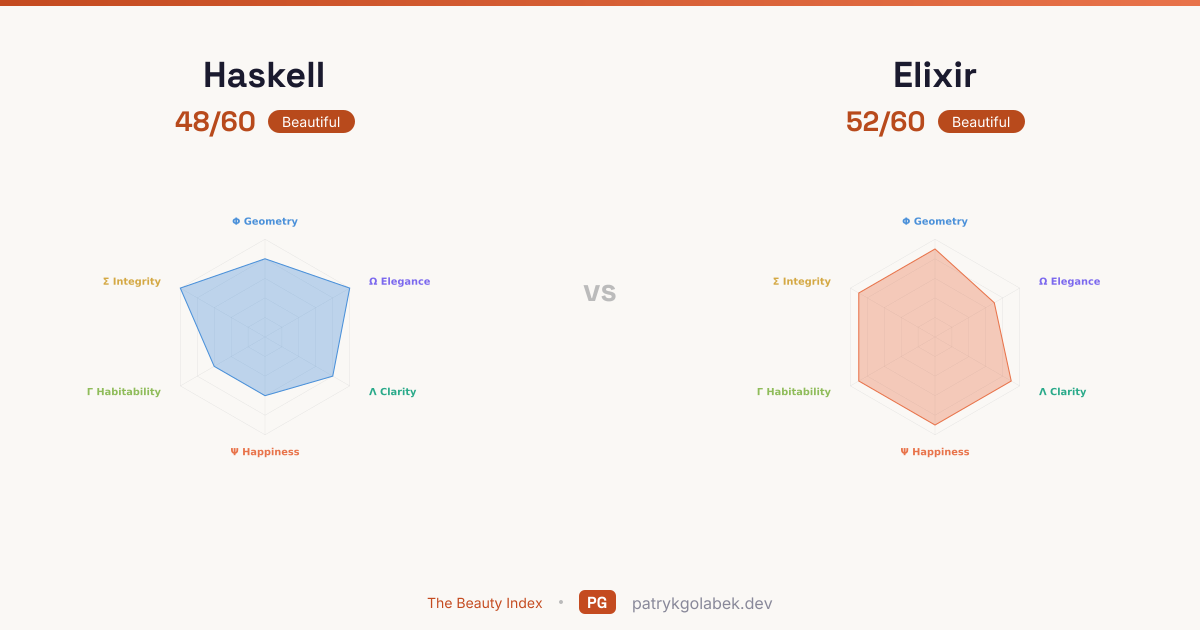
Elixir scores 52/60 against Haskell's 48/60, leading in 4 of 6 dimensions. Haskell owns mathematical and design while Elixir leads in aesthetic and human. The widest gap sits on Organic Habitability, where Elixir's 3-point lead over Haskell shapes most of the pair's character.
See also: PHP vs Elixir , Haskell .
Dimension-by-dimension analysis
Γ Organic Habitability
Elixir wins Organic Habitability by 3 points — an unmistakable lead in how well code ages. Pipelines are growth-point idioms, insert a transformation step anywhere without restructuring. OTP's supervision trees are the embodiment of habitable architecture: systems designed to fail gracefully and be extended incrementally. Elixir invites modification; Haskell rewards planning more than adjustment. Purity is a double-edged sword, you can't "just add a side effect here" without restructuring. Changing one type signature can cascade through an entire module. Haskell code is correct but often brittle to modify, which is the opposite of Gabriel's habitability ideal. In high-level work, the language that welcomes modification wins the decade, not the quarter.
Ω Mathematical Elegance
Haskell wins Mathematical Elegance by 3 points — a genuine expressive lead. The gold standard. fibs = 0 : 1 : zipWith (+) fibs (tail fibs) defines infinity by self-reference. Purity, lazy evaluation, and higher-kinded types let algorithms approach Erdős's "Book" proofs. No other language comes close. Where Haskell compresses an idea into a line or two, Elixir tends to spread the same idea across a paragraph. Pattern matching, recursion, and immutable data structures support elegant algorithm expression. Not as abstract as Haskell or OCaml, but the BEAM VM's concurrency primitives give certain distributed algorithms an inevitable quality. The winner lets the author think in algorithms rather than in ceremony.
Ψ Practitioner Happiness
Elixir wins Practitioner Happiness by 3 points — a decisive cultural edge. Stack Overflow admiration at 66%. The Phoenix framework, LiveView, and OTP give practitioners a feeling of building something that "just works." The community is small but deeply enthusiastic and welcoming. Where Elixir feels designed for the human, Haskell feels designed for the machine first — the human catches up second. Moderate Stack Overflow admiration (~57%), well below Rust, Elixir, or Gleam. The learning curve is brutal, Cabal/Stack tooling fragmentation has caused years of pain, and cryptic error messages for type-level code create real frustration. The community is passionate but small. Developers admire Haskell more than they enjoy it day-to-day. The winner here invites the next generation of contributors without asking them to earn it first.
Λ Linguistic Clarity
Elixir edges Haskell by a single point on Linguistic Clarity; the practical difference is slim but real. The pipe operator (|>) turns data transformation into a readable narrative. "hello" |> String.split() |> Enum.map(&String.capitalize/1) reads as a clear sequence of intentions. Among the most literate functional languages. The difference is real but modest — pick either and a team will read fluently within weeks. Simple Haskell reads like mathematics rendered in prose. Point-free style and function composition create elegant chains of meaning. Docked from 9 because lens operators (^., .~) and advanced type-level code can be opaque even to intermediate Haskellers. In high-level work, readable code is the difference between a 6-month onboarding and a 6-week one.
Φ Aesthetic Geometry
Elixir edges Haskell by a single point on Aesthetic Geometry; the practical difference is slim but real. Pipeline operators, pattern-matching clauses, and module structure create a visual flow that scans beautifully. Elixir code looks like a series of clean, evenly weighted transformation steps. The edge here is thin; a seasoned reader might prefer one strictly on personal taste. Clean Haskell is visually striking, where clauses, pattern matching, and type signatures create a structured, proportional layout. Docked from 9 because production Haskell with GADTs and monad transformer stacks can produce dense type-signature walls. In a language where expressiveness is the selling point, visual calm amplifies the advantage.
Σ Conceptual Integrity
Haskell edges Elixir by a single point on Conceptual Integrity; the practical difference is slim but real. "Avoid success at all costs." Haskell is about something: purity, types, and mathematical foundations. Every feature follows from a coherent worldview. It's the most internally consistent language design on this list. The integrity gap is narrow and more visible in edge cases than in everyday code. "Erlang's power with modern syntax." José Valim had a clear vision: bring functional programming and fault-tolerant concurrency to a wider audience. The language feels designed by one mind with a singular purpose. In high-level work a coherent philosophy is the frame that holds the language's features together.
Code comparison
Native pattern matching constructs for destructuring and control flow.
describe :: (Show a, Num a, Ord a) => [a] -> Stringdescribe xs = case xs of [] -> "empty" [x] -> "singleton: " ++ show x [x,y] -> "pair: " ++ show x ++ "," ++ show y (x:_) | x > 0 -> "starts positive" | otherwise -> "starts non-positive"case list do [] -> "empty" [x] -> "just #{x}" [h | _] when h > 0 -> "starts positive" _ -> "other"end
# Function clause pattern matching (inside a module)# def handle({:ok, result}), do: result# def handle({:error, reason}), do: raise reason
{:ok, value} = {:ok, 42}Data structure definition using classes, structs, records, or equivalent.
data User = User  { userName  :: String  , userEmail :: String  , userAge   :: Int  } deriving (Show, Eq)
data Shape = Circle Double | Rectangle Double Doubledefmodule User do defstruct [:name, :email, age: 0]
def new(name, email, age) do %User{name: name, email: email, age: age} end
def greeting(%User{name: name}) do "Hello, #{name}!" endendException handling via try/catch or Result/Either patterns.
type Error = String
safeDivide :: Double -> Double -> Either Error DoublesafeDivide _ 0 = Left "Division by zero"safeDivide a b = Right (a / b)
compute :: Either Error Doublecompute = do x <- safeDivide 10 2 y <- safeDivide x 3 return (x + y)with {:ok, user} <- fetch_user(id), {:ok, posts} <- fetch_posts(user.id), {:ok, _} <- validate(posts) do {:ok, format_response(user, posts)}else {:error, :not_found} -> {:error, "User not found"} {:error, reason} -> {:error, reason}endFrequently asked questions
- Which is easier to learn, Haskell or Elixir?
- Elixir scores 9 on Practitioner Happiness versus Haskell's 6. Stack Overflow admiration at 66%. The Phoenix framework, LiveView, and OTP give practitioners a feeling of building something that "just works." The community is small but deeply enthusiastic and welcoming. For a newcomer picking up their first serious language in 2026, the happiness-score winner is the more forgiving starting point.
- Is Haskell or Elixir better for long-lived codebases?
- For long-lived codebases, Elixir has a clear edge — it scores 9/10 on Organic Habitability against Haskell's 6/10. Pipelines are growth-point idioms, insert a transformation step anywhere without restructuring. OTP's supervision trees are the embodiment of habitable architecture: systems designed to fail gracefully and be extended incrementally.
- Should I pick Haskell or Elixir in 2026?
- Haskell lands in the beautiful tier at 48/60; Elixir in the beautiful tier at 52/60. The gap is wide enough to matter in day-to-day experience. Pick the higher scorer unless a hard constraint pushes otherwise. The score difference reflects years of community use, tooling maturity, and the editorial judgment of the Beauty Index rubric.