
Haskell vs Dart
Haskell
The beautifully dressed philosopher who can't find their car keys. Haskell writes the most elegant code in any language, then spends 45 minutes explaining why IO is actually a monad.
Dart
The second-chance kid who found their calling in Flutter. Dart was nearly forgotten until mobile development gave it a purpose, and now it's living its best life painting pixels.
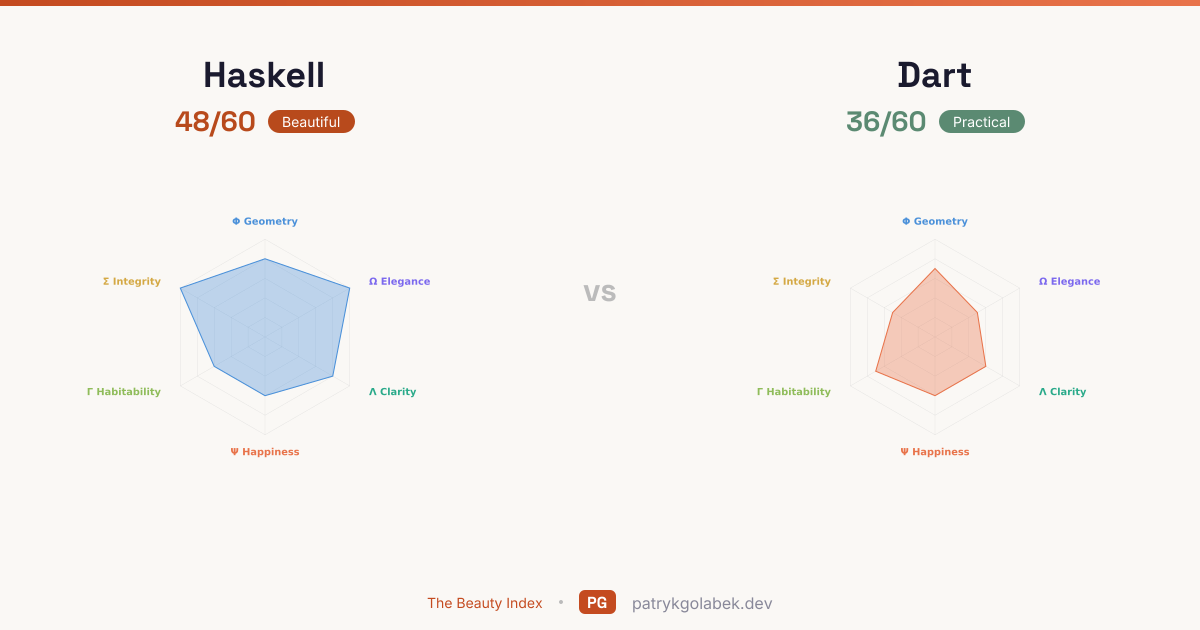
Haskell scores 48/60 against Dart's 36/60, leading in 4 of 6 dimensions. Haskell dominates the aesthetic, mathematical, and design axes. The widest gap sits on Mathematical Elegance, where Haskell's 5-point lead over Dart shapes most of the pair's character.
See also: C# vs Dart , Haskell .
Dimension-by-dimension analysis
Ω Mathematical Elegance
Haskell wins Mathematical Elegance by 5 points — a substantive reach beyond idiom. The gold standard. fibs = 0 : 1 : zipWith (+) fibs (tail fibs) defines infinity by self-reference. Purity, lazy evaluation, and higher-kinded types let algorithms approach Erdős's "Book" proofs. No other language comes close. The gap on Elegance is real: Haskell rewards precise thought, Dart rewards precise bookkeeping. Dart is a pragmatic language without strong mathematical abstractions. It does what it needs to for UI programming. Generics and async/await are useful but not mathematically elegant. The winner lets the author think in algorithms rather than in ceremony.
Σ Conceptual Integrity
Haskell wins Conceptual Integrity by 5 points — an unmistakable unity of purpose. "Avoid success at all costs." Haskell is about something: purity, types, and mathematical foundations. Every feature follows from a coherent worldview. It's the most internally consistent language design on this list. Where Haskell holds a line, Dart has negotiated with history, ecosystems, and legacy users. Dart's identity crisis, initially a web language, then reborn as a Flutter companion, weakens its conceptual integrity. It's a good language in service of a framework, not a language with its own philosophical center. The winner's philosophical discipline is what keeps its idioms stable as the language evolves.
Λ Linguistic Clarity
Haskell wins Linguistic Clarity by 2 points — an unmistakable prose-like flow. Simple Haskell reads like mathematics rendered in prose. Point-free style and function composition create elegant chains of meaning. Docked from 9 because lens operators (^., .~) and advanced type-level code can be opaque even to intermediate Haskellers. Haskell reads like a well-edited paragraph; Dart reads like a sentence that is still being translated. Readable and predictable. Named parameters, cascade notation (..), and clear class syntax make intent visible. Not particularly literary, but consistently clear. For application code the clarity advantage is the whole point of the language category.
Γ Organic Habitability
Dart edges Haskell by a single point on Organic Habitability; the practical difference is slim but real. Dart codebases grow well within the Flutter paradigm. The widget composition model encourages incremental, modular extension. Sound null safety (added retroactively) improved long-term maintainability. On extensibility the two are close enough that the decision rarely hinges on this axis alone. Purity is a double-edged sword, you can't "just add a side effect here" without restructuring. Changing one type signature can cascade through an entire module. Haskell code is correct but often brittle to modify, which is the opposite of Gabriel's habitability ideal. The winner here is the language you will still enjoy reading in five years.
Φ Aesthetic Geometry
Haskell edges Dart by a single point on Aesthetic Geometry; the practical difference is slim but real. Clean Haskell is visually striking, where clauses, pattern matching, and type signatures create a structured, proportional layout. Docked from 9 because production Haskell with GADTs and monad transformer stacks can produce dense type-signature walls. Haskell edges ahead on visual rhythm, but Dart is comfortably readable in its own right. Dart's syntax is clean and visually familiar to Java/JavaScript developers. Flutter's widget tree syntax, with its trailing commas and nested constructors, has a structured, tree-like visual geometry. In a language where expressiveness is the selling point, visual calm amplifies the advantage.
Ψ Practitioner Happiness
Both score 6 — this is one dimension where Haskell and Dart genuinely agree. Moderate Stack Overflow admiration (~57%), well below Rust, Elixir, or Gleam. The learning curve is brutal, Cabal/Stack tooling fragmentation has caused years of pain, and cryptic error messages for type-level code create real frustration. The community is passionate but small. Developers admire Haskell more than they enjoy it day-to-day. On happiness the verdict is a draw — choose based on what the work demands, not on what feels good. Flutter developers generally enjoy the experience. Hot reload is a genuine joy. The language itself is pleasant enough, but Dart's identity is inseparable from Flutter, outside that context, enthusiasm drops significantly. The winner here invites the next generation of contributors without asking them to earn it first.
Code comparison
The characteristic code snippet that best represents each language.
quicksort :: Ord a => [a] -> [a]quicksort [] = []quicksort (x:xs) = quicksort smaller ++ [x] ++ quicksort bigger where smaller = [a | a <- xs, a <= x] bigger = [a | a <- xs, a > x]final paint = Paint() ..color = Colors.blue ..strokeWidth = 4.0 ..style = PaintingStyle.stroke;
final path = Path() ..moveTo(0, 0) ..lineTo(100, 0) ..lineTo(100, 100) ..close();
canvas.drawPath(path, paint);For/while iteration patterns and loop constructs.
-- Haskell uses recursion, not loopsfactorial :: Integer -> Integerfactorial 0 = 1factorial n = n * factorial (n - 1)
evens :: [Int] -> [Int]evens xs = [x | x <- xs, even x]for (final item in items) { print(item);}
for (var i = 0; i < 10; i++) { print(i);}
var sum = 0;while (sum < 100) { sum += 10; }Data structure definition using classes, structs, records, or equivalent.
data User = User  { userName  :: String  , userEmail :: String  , userAge   :: Int  } deriving (Show, Eq)
data Shape = Circle Double | Rectangle Double Doubleclass User { final String name; final String email; final int age;
const User({ required this.name, required this.email, this.age = 0, });
String greeting() => 'Hello, $name!';}Frequently asked questions
- Which is easier to learn, Haskell or Dart?
- Haskell and Dart are tied on Practitioner Happiness at 6/10 — both are broadly welcoming to newcomers. Moderate Stack Overflow admiration (~57%), well below Rust, Elixir, or Gleam. The learning curve is brutal, Cabal/Stack tooling fragmentation has caused years of pain, and cryptic error messages for type-level code create real frustration. The community is passionate but small. Developers admire Haskell more than they enjoy it day-to-day. For a newcomer picking up their first serious language in 2026, the happiness-score winner.
- Is Haskell or Dart better for algorithm-heavy code?
- For algorithm-heavy code, Haskell has a clear edge — it scores 10/10 on Mathematical Elegance against Dart's 5/10. The gold standard. fibs = 0 : 1 : zipWith (+) fibs (tail fibs) defines infinity by self-reference. Purity, lazy evaluation, and higher-kinded types let algorithms approach Erdős's "Book" proofs. No other language comes close.
- Should I pick Haskell or Dart in 2026?
- Haskell lands in the beautiful tier at 48/60; Dart in the practical tier at 36/60. On this score difference the answer is clear: the higher-ranked language wins unless you have an explicit reason to pay the cost of the other.