
Haskell vs C#
Haskell
The beautifully dressed philosopher who can't find their car keys. Haskell writes the most elegant code in any language, then spends 45 minutes explaining why IO is actually a monad.
C#
The corporate executive who secretly writes poetry. C# started as a Java clone in a suit, then quietly evolved into one of the most feature-complete languages ever designed.
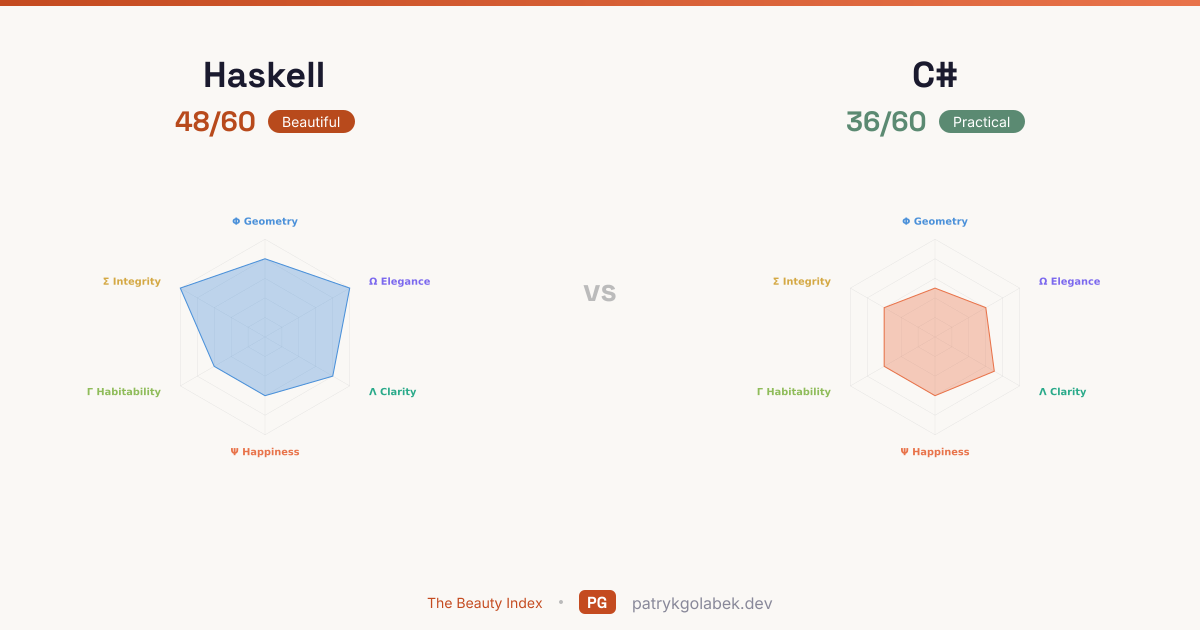
Haskell scores 48/60 against C#'s 36/60, leading in 4 of 6 dimensions. Haskell dominates the aesthetic, mathematical, and design axes. The widest gap sits on Mathematical Elegance, where Haskell's 4-point lead over C# shapes most of the pair's character.
See also: Dart vs C# , Haskell .
Dimension-by-dimension analysis
Ω Mathematical Elegance
Haskell wins Mathematical Elegance by 4 points — a genuine expressive lead. The gold standard. fibs = 0 : 1 : zipWith (+) fibs (tail fibs) defines infinity by self-reference. Purity, lazy evaluation, and higher-kinded types let algorithms approach Erdős's "Book" proofs. No other language comes close. Where Haskell compresses an idea into a line or two, C# tends to spread the same idea across a paragraph. LINQ is genuinely elegant, embedding query algebra into the type system is a real achievement. Pattern matching in C# 11+ is increasingly expressive. But the OOP substrate limits how close algorithms can get to mathematical notation. For high-level work, the gap compounds: fewer lines per algorithm means fewer bugs per feature.
Σ Conceptual Integrity
Haskell wins Conceptual Integrity by 4 points — a clear integrity advantage. "Avoid success at all costs." Haskell is about something: purity, types, and mathematical foundations. Every feature follows from a coherent worldview. It's the most internally consistent language design on this list. The design philosophy of Haskell feels inevitable, each feature a consequence of one idea — C# feels assembled from several good ideas instead of from one great one. Anders Hejlsberg has maintained a clearer vision than most credit, async/await, LINQ, and pattern matching feel designed rather than patched on. But the steady feature accumulation over 25 years does dilute the singular "language soul." C# is coherent, not focused. The winner's philosophical discipline is what keeps its idioms stable as the language evolves.
Φ Aesthetic Geometry
Haskell wins Aesthetic Geometry by 3 points — a clear geometric edge. Clean Haskell is visually striking, where clauses, pattern matching, and type signatures create a structured, proportional layout. Docked from 9 because production Haskell with GADTs and monad transformer stacks can produce dense type-signature walls. C#, by contrast, accepts visual density in exchange for other priorities. C# has reduced ceremony significantly with top-level statements, records, and file-scoped namespaces. But the language's Java-era heritage still shows in verbose patterns, property accessors, attribute decorations, and using blocks add visual weight. Improving, but not yet clean. In a language where expressiveness is the selling point, visual calm amplifies the advantage.
Λ Linguistic Clarity
Haskell edges C# by a single point on Linguistic Clarity; the practical difference is slim but real. Simple Haskell reads like mathematics rendered in prose. Point-free style and function composition create elegant chains of meaning. Docked from 9 because lens operators (^., .~) and advanced type-level code can be opaque even to intermediate Haskellers. Both Haskell and C# communicate their intent without heroic effort; Haskell is only a little more forgiving. Modern C# reads well, async/await patterns are clear, LINQ chains communicate intent, and named arguments help. The language has steadily improved its Knuthian "wit" with each version. For application code the clarity advantage is the whole point of the language category.
Γ Organic Habitability
Both score 6 — this is one dimension where Haskell and C# genuinely agree. Purity is a double-edged sword, you can't "just add a side effect here" without restructuring. Changing one type signature can cascade through an entire module. Haskell code is correct but often brittle to modify, which is the opposite of Gabriel's habitability ideal. Both Haskell and C# have proven they can carry code across decades — this is not where they differ. C#'s backward compatibility and incremental feature additions mean codebases can adopt new patterns gradually. The ecosystem is mature and battle-tested. Docked because the language's breadth (OOP + FP + async + LINQ + dynamic) means codebases vary widely in style. For application codebases the habitability edge determines whether a project survives its second rewrite.
Ψ Practitioner Happiness
Both score 6 — this is one dimension where Haskell and C# genuinely agree. Moderate Stack Overflow admiration (~57%), well below Rust, Elixir, or Gleam. The learning curve is brutal, Cabal/Stack tooling fragmentation has caused years of pain, and cryptic error messages for type-level code create real frustration. The community is passionate but small. Developers admire Haskell more than they enjoy it day-to-day. On happiness the verdict is a draw — choose based on what the work demands, not on what feels good. Modern .NET is a pleasure to use, excellent tooling (Rider, VS Code, hot reload), rapid language evolution, and an engaged community. Stack Overflow admiration is solid and improving. The "corporate Java clone" reputation is outdated but sticky, and the developer experience has genuinely earned a higher mark than the old perception suggests. The winner here invites the next generation of contributors without asking them to earn it first.
Code comparison
For/while iteration patterns and loop constructs.
-- Haskell uses recursion, not loopsfactorial :: Integer -> Integerfactorial 0 = 1factorial n = n * factorial (n - 1)
evens :: [Int] -> [Int]evens xs = [x | x <- xs, even x]foreach (var item in items){ Console.WriteLine(item);}
for (var i = 0; i < 10; i++){ Console.WriteLine(i);}
var sum = 0;while (sum < 100) sum += 10;The characteristic code snippet that best represents each language.
quicksort :: Ord a => [a] -> [a]quicksort [] = []quicksort (x:xs) = quicksort smaller ++ [x] ++ quicksort bigger where smaller = [a | a <- xs, a <= x] bigger = [a | a <- xs, a > x]var summary = from order in orders where order.Date.Year == 2024 group order by order.Category into g orderby g.Sum(o => o.Total) descending select new { Category = g.Key, Revenue = g.Sum(o => o.Total), Count = g.Count() };Exception handling via try/catch or Result/Either patterns.
type Error = String
safeDivide :: Double -> Double -> Either Error DoublesafeDivide _ 0 = Left "Division by zero"safeDivide a b = Right (a / b)
compute :: Either Error Doublecompute = do x <- safeDivide 10 2 y <- safeDivide x 3 return (x + y)try{ var result = int.Parse(input); Console.WriteLine(result * 2);}catch (FormatException e) when (e.Message.Contains("Input")){ Console.WriteLine($"Invalid: {e.Message}");}catch (Exception e){ Console.WriteLine($"Error: {e.Message}");}finally { Cleanup(); }Frequently asked questions
- Which is easier to learn, Haskell or C#?
- Haskell and C# are tied on Practitioner Happiness at 6/10 — both are broadly welcoming to newcomers. Moderate Stack Overflow admiration (~57%), well below Rust, Elixir, or Gleam. The learning curve is brutal, Cabal/Stack tooling fragmentation has caused years of pain, and cryptic error messages for type-level code create real frustration. The community is passionate but small. Developers admire Haskell more than they enjoy it day-to-day. When ease of learning is the deciding factor, the happier community wins every time.
- Is Haskell or C# better for algorithm-heavy code?
- For algorithm-heavy code, Haskell has a clear edge — it scores 10/10 on Mathematical Elegance against C#'s 6/10. The gold standard. fibs = 0 : 1 : zipWith (+) fibs (tail fibs) defines infinity by self-reference. Purity, lazy evaluation, and higher-kinded types let algorithms approach Erdős's "Book" proofs. No other language comes close.
- Should I pick Haskell or C# in 2026?
- Haskell lands in the beautiful tier at 48/60; C# in the practical tier at 36/60. On this score difference the answer is clear: the higher-ranked language wins unless you have an explicit reason to pay the cost of the other.