
Go vs Rust
Go
The minimalist architect who removed every feature you loved and somehow built something better. Go proves that what you leave out matters more than what you put in.
Rust
The overprotective friend who's always right. Rust won't let you make mistakes, and you'll resent it until you realize every error it caught would have been a 3am production incident.
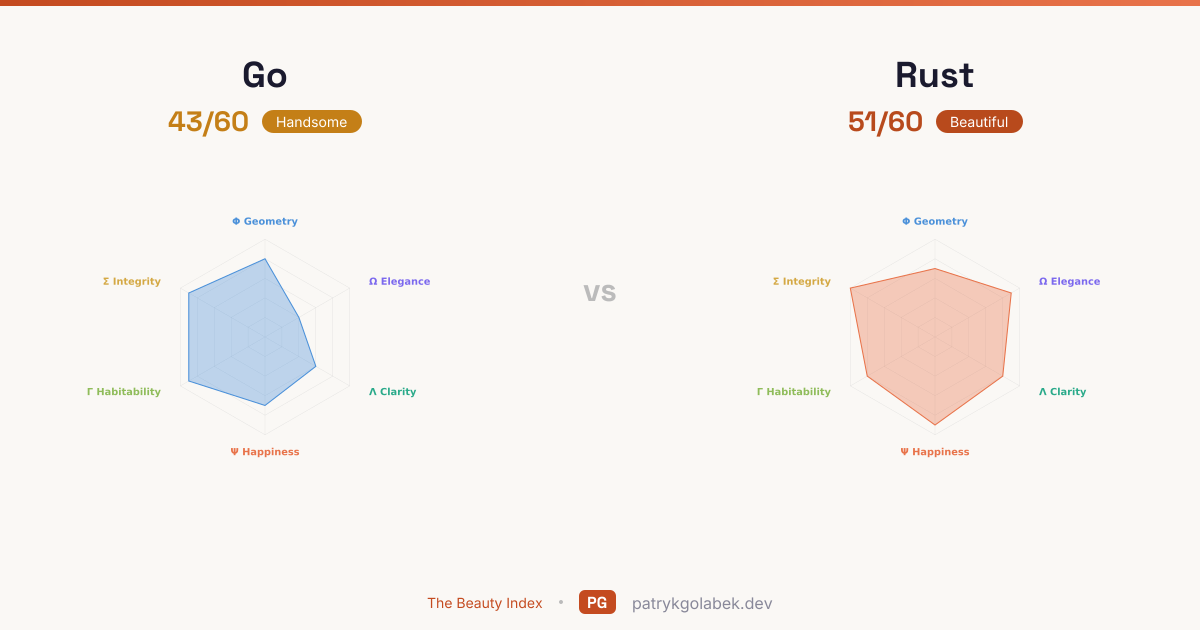
Rust scores 51/60 against Go's 43/60, leading in 4 of 6 dimensions. Rust dominates the aesthetic, mathematical, human, and design axes. Choose Rust if the next six months are what matter, Go if the next six years are.
See also: PHP vs Rust , Go .
Dimension-by-dimension analysis
Ω Mathematical Elegance
Rust wins Mathematical Elegance by 5 points — a clear algorithmic edge. Algebraic data types, pattern matching, and zero-cost abstractions let you write algorithms that feel close to mathematical proofs. Ownership annotations interrupt the flow slightly — the ceremony is justified but still ceremony. The gap on Elegance is real: Rust rewards precise thought, Go rewards precise bookkeeping. Go deliberately avoids mathematical abstraction. No generics (until recently, and limited), no algebraic types, no higher-order patterns. Algorithms in Go are written out explicitly, which is the opposite of Hardy's "economy." The philosophy is valid, but Omega measures what it measures. Elegance under tight constraints is the hardest kind; the winner here does not take it for granted.
Λ Linguistic Clarity
Rust wins Linguistic Clarity by 2 points — a real readability advantage. Trait-based design, expressive enums, and the ? operator make intent clear. Rust rewards you with readable code once you know the idioms. Lifetime annotations are information for the compiler rather than the human reader, which docks it from 9. Where Rust favours plain intent, Go trades clarity for control, capability, or history. Go is verbose but never confusing. There is zero ambiguity about what any line does. if err != nil is noise, but the signal-to-noise ratio on intent is actually quite high because the language has so few constructs. "Technical manual" clarity, not literary, but reliably communicative. The winner proves that proximity to the machine need not mean distance from the reader.
Ψ Practitioner Happiness
Rust wins Practitioner Happiness by 2 points — an unmistakable experiential gap. Topped Stack Overflow's "Most Admired" for 7+ consecutive years at 72%. The community is evangelical in its love. Compiler error messages are genuinely helpful. The "fighting the borrow checker" phase gives way to deep satisfaction. Rust has done the harder cultural work: tooling that delights, a community that welcomes, documentation that explains. Excellent tooling (go fmt, go vet, go test, go mod), fast compilation, and simplicity that induces flow states. Docked from higher because the enforced simplicity can feel constraining, and the if err != nil repetition is a genuine pain point. Even in low-level work the human experience matters — the winner proves systems code need not be joyless.
Γ Organic Habitability
Go edges Rust by a single point on Organic Habitability; the practical difference is slim but real. Go codebases are among the most maintainable in any language. The limited feature set means less stylistic drift over time. New developers can contribute immediately. Code ages gracefully because there's only one way to write it. Both Go and Rust age reasonably well; Go is merely a little kinder to the future reader. Ownership rules force you to think about structure upfront, which often produces code that ages well. Some modifications ("I just wanted to add a reference here") cascade more than expected, but the type system catches the fallout. The habitability advantage compounds across decades of maintenance.
Φ Aesthetic Geometry
Go edges Rust by a single point on Aesthetic Geometry; the practical difference is slim but real. gofmt produces the most visually uniform code of any language. Every Go file looks the same. Enforced formatting eliminates style debates entirely, this is the Bauhaus ideal realized through tooling. The edge here is thin; a seasoned reader might prefer one strictly on personal taste. rustfmt enforces strong visual consistency, and match arms, impl blocks, and module structure create clear visual architecture. Docked because lifetime annotations, turbofish (::<>), and trait bounds add visual noise that breaks geometric serenity. In systems work the visual cost shows up in long functions; the winner here saves attention across a full file.
Σ Conceptual Integrity
Rust edges Go by a single point on Conceptual Integrity; the practical difference is slim but real. "Safety without sacrificing control." Every feature (ownership, borrowing, lifetimes, traits) follows from this single idea. Rust is the most opinionated systems language ever designed, and every opinion is justified by the core philosophy. Both Go and Rust have coherent design philosophies; Rust merely holds to its centre with a firmer grip. "Simplicity is complicated." Rob Pike and Ken Thompson's vision is razor-sharp: remove every feature that isn't essential. Go is the most opinionated language about what it won't do, and that discipline is itself a form of conceptual integrity. The winner's design discipline pays off most under the extreme constraints systems work imposes.
Code comparison
Map, filter, reduce and functional collection transformations.
numbers := []int{1, 2, 3, 4, 5, 6, 7, 8, 9, 10}
var evens []intfor _, n := range numbers {    if n%2 == 0 {        evens = append(evens, n)    }}
sum := 0for _, n := range numbers { sum += n}let numbers = vec![1, 2, 3, 4, 5, 6, 7, 8, 9, 10];
let result: Vec<i32> = numbers.iter() .filter(|&&n| n % 2 == 0) .map(|&n| n * n) .collect();
let sum: i32 = numbers.iter().sum();Basic variable syntax, type annotations, and initialization patterns.
The characteristic code snippet that best represents each language.
func fanIn(channels ...<-chan string) <-chan string { merged := make(chan string) var wg sync.WaitGroup for _, ch := range channels { wg.Add(1) go func(c <-chan string) { defer wg.Done() for msg := range c { merged <- msg } }(ch) } go func() { wg.Wait(); close(merged) }() return merged}enum Shape { Circle(f64), Rectangle(f64, f64), Triangle(f64, f64, f64),}
fn area(shape: &Shape) -> f64 { match shape { Shape::Circle(r) => std::f64::consts::PI * r * r, Shape::Rectangle(w, h) => w * h, Shape::Triangle(a, b, c) => { let s = (a + b + c) / 2.0; (s * (s - a) * (s - b) * (s - c)).sqrt() } }}Frequently asked questions
- Which is easier to learn, Go or Rust?
- Rust scores 9 on Practitioner Happiness versus Go's 7. Topped Stack Overflow's "Most Admired" for 7+ consecutive years at 72%. The community is evangelical in its love. Compiler error messages are genuinely helpful. The "fighting the borrow checker" phase gives way to deep satisfaction. For classroom or self-directed study, the practitioner-happiness winner almost always has better learning materials and kinder error messages.
- Is Go or Rust better for algorithm-heavy code?
- For algorithm-heavy code, Rust has a clear edge — it scores 9/10 on Mathematical Elegance against Go's 4/10. Algebraic data types, pattern matching, and zero-cost abstractions let you write algorithms that feel close to mathematical proofs. Ownership annotations interrupt the flow slightly — the ceremony is justified but still ceremony.
- Should I pick Go or Rust in 2026?
- Go lands in the handsome tier at 43/60; Rust in the beautiful tier at 51/60. The score gap is real; the higher-scoring language has a measurable edge. Go the other way only if a concrete ecosystem need pulls you there.