
Go vs PHP
Go
The minimalist architect who removed every feature you loved and somehow built something better. Go proves that what you leave out matters more than what you put in.
PHP
The duct tape that holds 40% of the web together while everyone pretends it doesn't exist. PHP is the cockroach of programming: ugly, everywhere, and absolutely unkillable.
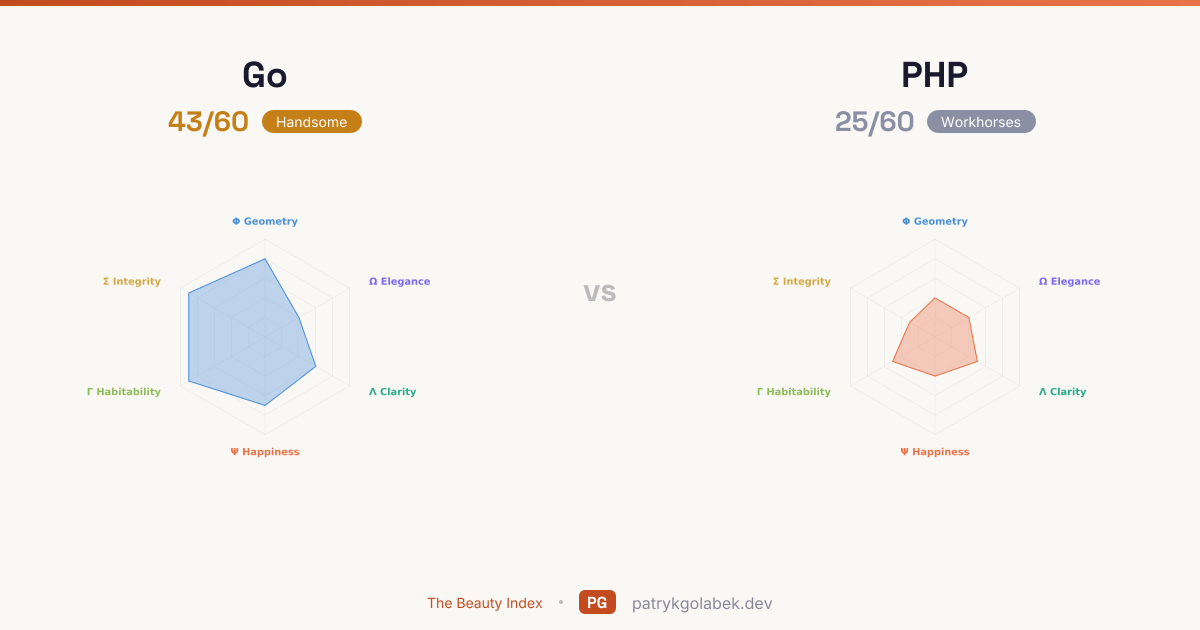
Go scores 43/60 against PHP's 25/60, leading in 5 of 6 dimensions. Go dominates the aesthetic, human, and design axes. Conceptual Integrity is where the pair separates most cleanly — Go leads PHP by 6 points and that gap colours everything else on the page.
See also: Go vs Julia , Go .
Dimension-by-dimension analysis
Σ Conceptual Integrity
Go wins Conceptual Integrity by 6 points — a genuine lead in design coherence. "Simplicity is complicated." Rob Pike and Ken Thompson's vision is razor-sharp: remove every feature that isn't essential. Go is the most opinionated language about what it won't do, and that discipline is itself a form of conceptual integrity. The design philosophy of Go feels inevitable, each feature a consequence of one idea — PHP feels assembled from several good ideas instead of from one great one. PHP was not designed; it was accumulated. Rasmus Lerdorf's personal homepage tools grew into a language without a coherent philosophy. Each version has improved quality, but there is no "soul", no single idea that all features follow from. The quintessential committee language. Philosophical unity in a systems language is a rare and load-bearing virtue.
Γ Organic Habitability
Go wins Organic Habitability by 4 points — a real habitability advantage. Go codebases are among the most maintainable in any language. The limited feature set means less stylistic drift over time. New developers can contribute immediately. Code ages gracefully because there's only one way to write it. Where Go accommodates change gracefully, PHP makes you earn each new direction. PHP codebases survive, 77% of the web runs on PHP, and that code keeps working. The language is pragmatically habitable. But the inconsistent standard library and multiple paradigm shifts (procedural → OOP → modern PHP) make long-term evolution uneven. In systems work habitability is rare — the winner has managed to make change cheap without sacrificing correctness.
Φ Aesthetic Geometry
Go wins Aesthetic Geometry by 4 points — a meaningful cleanliness gap. gofmt produces the most visually uniform code of any language. Every Go file looks the same. Enforced formatting eliminates style debates entirely, this is the Bauhaus ideal realized through tooling. The difference is not cosmetic: Go rewards the eye, while PHP asks the reader to absorb more punctuation and more ceremony. $ on every variable, -> for method calls, inconsistent brace styles across frameworks, and <?php tags create visual clutter. Modern PHP (8.x) with named arguments and match expressions is cleaner, but the legacy visual debt remains. The geometric advantage is felt most on the hundredth line, not the tenth.
Ψ Practitioner Happiness
Go wins Practitioner Happiness by 3 points — an unmistakable experiential gap. Excellent tooling (go fmt, go vet, go test, go mod), fast compilation, and simplicity that induces flow states. Docked from higher because the enforced simplicity can feel constraining, and the if err != nil repetition is a genuine pain point. Where Go feels designed for the human, PHP feels designed for the machine first — the human catches up second. PHP developers themselves joke about PHP. The community is large and productive, but "most admired" it is not. Modern PHP (8.x with Laravel) has improved the experience significantly, but the reputation, and the daily reality of legacy code, weighs on happiness. The practitioner-happiness edge in a systems language is unusual and worth noting.
Λ Linguistic Clarity
Go edges PHP by a single point on Linguistic Clarity; the practical difference is slim but real. Go is verbose but never confusing. There is zero ambiguity about what any line does. if err != nil is noise, but the signal-to-noise ratio on intent is actually quite high because the language has so few constructs. "Technical manual" clarity, not literary, but reliably communicative. On readability the edge is slim and disappears quickly as idioms are learned. PHP can be readable in modern frameworks (Laravel's fluent syntax reads well). But str_replace vs. strpos vs. substr, inconsistent parameter ordering, and the legacy API are the antithesis of linguistic clarity. Two PHPs coexist: modern and legacy. The winner proves that proximity to the machine need not mean distance from the reader.
Ω Mathematical Elegance
Both score 4 — this is one dimension where Go and PHP genuinely agree. Go deliberately avoids mathematical abstraction. No generics (until recently, and limited), no algebraic types, no higher-order patterns. Algorithms in Go are written out explicitly, which is the opposite of Hardy's "economy." The philosophy is valid, but Omega measures what it measures. When it comes to reaching "The Book," these two arrive together. PHP is a templating language that grew into a general-purpose one. Array functions exist but lack the composability of functional languages. Mathematical elegance is not the design space PHP occupies. When performance and precision matter, the language that expresses the algorithm most directly wins twice.
Code comparison
The characteristic code snippet that best represents each language.
func fanIn(channels ...<-chan string) <-chan string { merged := make(chan string) var wg sync.WaitGroup for _, ch := range channels { wg.Add(1) go func(c <-chan string) { defer wg.Done() for msg := range c { merged <- msg } }(ch) } go func() { wg.Wait(); close(merged) }() return merged}$results = array_map( fn($user) => [ 'name' => $user['name'], 'email' => strtolower($user['email']), 'score' => array_sum($user['grades']) / count($user['grades']), ], array_filter( $users, fn($u) => $u['active'] && count($u['grades']) > 0 ));Map, filter, reduce and functional collection transformations.
numbers := []int{1, 2, 3, 4, 5, 6, 7, 8, 9, 10}
var evens []intfor _, n := range numbers {    if n%2 == 0 {        evens = append(evens, n)    }}
sum := 0for _, n := range numbers { sum += n}$numbers = range(1, 10);
$doubled = array_map(fn($n) => $n * 2, $numbers);$evens = array_filter($numbers, fn($n) => $n % 2 === 0);$total = array_sum($numbers);
$result = array_map( fn($n) => $n ** 2, array_filter($numbers, fn($n) => $n % 2 === 0));Embedding expressions and variables within string literals.
name := "Go"version := 1.22
msg := fmt.Sprintf("Hello, %s! Version: %.2f", name, version)aligned := fmt.Sprintf("%-10s | %5.2f", name, version)
fmt.Printf("Welcome to %s.\nVersion: %v\n", name, version)$name = 'PHP';$version = 8.3;
$msg = "Hello, $name! Version: $version";$expr = "Length: " . strlen($name) . ", Upper: " . strtoupper($name);$heredoc = <<<EOTWelcome to $name.Version: $versionEOT;
$formatted = sprintf("%-10s | %5.1f", $name, $version);Frequently asked questions
- Which is easier to learn, Go or PHP?
- Go scores 7 on Practitioner Happiness versus PHP's 4. Excellent tooling (go fmt, go vet, go test, go mod), fast compilation, and simplicity that induces flow states. Docked from higher because the enforced simplicity can feel constraining, and the if err != nil repetition is a genuine pain point. For classroom or self-directed study, the practitioner-happiness winner almost always has better learning materials and kinder error messages.
- Is Go or PHP better for principled design?
- For principled design, Go has a clear edge — it scores 9/10 on Conceptual Integrity against PHP's 3/10. "Simplicity is complicated." Rob Pike and Ken Thompson's vision is razor-sharp: remove every feature that isn't essential. Go is the most opinionated language about what it won't do, and that discipline is itself a form of conceptual integrity.
- Should I pick Go or PHP in 2026?
- Go lands in the handsome tier at 43/60; PHP in the workhorses tier at 25/60. On this score difference the answer is clear: the higher-ranked language wins unless you have an explicit reason to pay the cost of the other.