
F# vs PHP
F#
The brilliant cousin nobody invites to parties. F# does everything right on the .NET platform, writes more elegant code than C# ever could, and wonders why nobody's paying attention.
PHP
The duct tape that holds 40% of the web together while everyone pretends it doesn't exist. PHP is the cockroach of programming: ugly, everywhere, and absolutely unkillable.
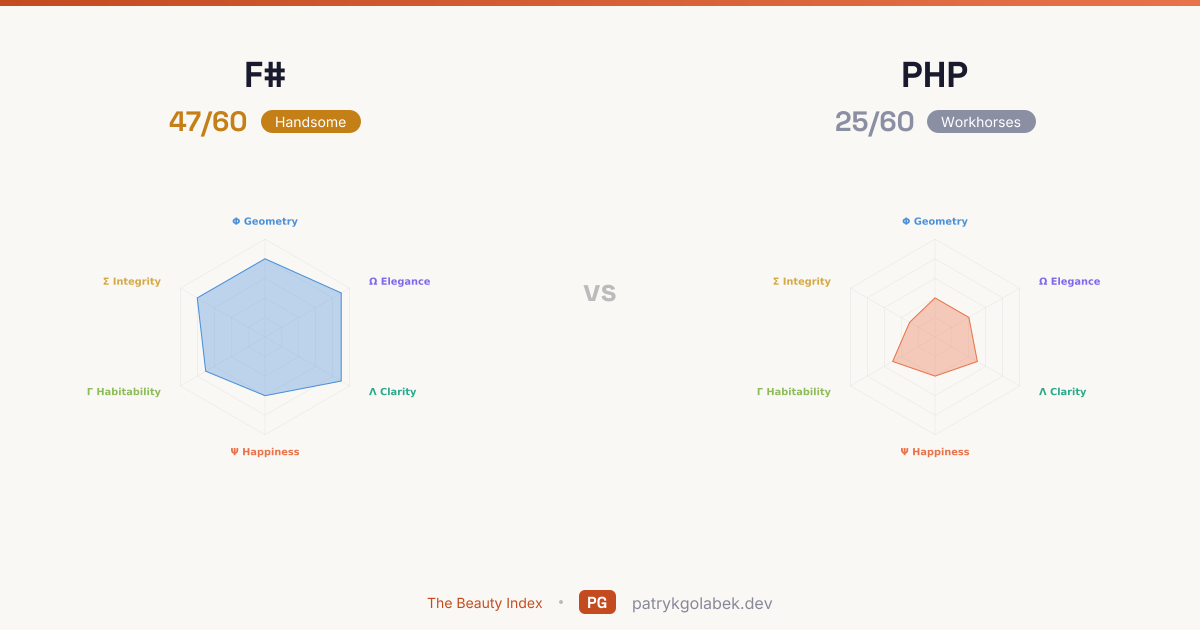
F# scores 47/60 against PHP's 25/60, leading in 6 of 6 dimensions. F# dominates the aesthetic, mathematical, human, and design axes. The widest gap sits on Mathematical Elegance, where F#'s 5-point lead over PHP shapes most of the pair's character.
See also: F# vs Gleam , F# .
Dimension-by-dimension analysis
Ω Mathematical Elegance
F# wins Mathematical Elegance by 5 points — a clear algorithmic edge. MetaLanguage-family heritage gives F# deep mathematical roots. Computation expressions, active patterns, and type providers enable algorithm expression that approaches Hardy's "economy" criterion. Where F# compresses an idea into a line or two, PHP tends to spread the same idea across a paragraph. PHP is a templating language that grew into a general-purpose one. Array functions exist but lack the composability of functional languages. Mathematical elegance is not the design space PHP occupies. In application code the elegance edge shows up as less boilerplate per idea.
Σ Conceptual Integrity
F# wins Conceptual Integrity by 5 points — a genuine lead in design coherence. "Functional-first on .NET" is a clear, focused vision that Don Syme has maintained consistently. F# knows what it is and doesn't try to be everything. The design is opinionated in the right ways. F# speaks with a single design voice; PHP speaks with a committee. PHP was not designed; it was accumulated. Rasmus Lerdorf's personal homepage tools grew into a language without a coherent philosophy. Each version has improved quality, but there is no "soul", no single idea that all features follow from. The quintessential committee language. The winner's philosophical discipline is what keeps its idioms stable as the language evolves.
Λ Linguistic Clarity
F# wins Linguistic Clarity by 4 points — a real readability advantage. The pipeline operator, discriminated unions, and lack of ceremony make F# remarkably readable. items |> List.filter isValid |> List.map transform reads as a clear chain of intent. One of the most literate typed languages. Where F# favours plain intent, PHP trades clarity for control, capability, or history. PHP can be readable in modern frameworks (Laravel's fluent syntax reads well). But str_replace vs. strpos vs. substr, inconsistent parameter ordering, and the legacy API are the antithesis of linguistic clarity. Two PHPs coexist: modern and legacy. In high-level work, readable code is the difference between a 6-month onboarding and a 6-week one.
Φ Aesthetic Geometry
F# wins Aesthetic Geometry by 4 points — a meaningful cleanliness gap. Significant whitespace, pipeline operators, and concise type definitions give F# a clean, proportional visual feel. Pattern matching arms align naturally. Less visual noise than C# by a wide margin. The difference is not cosmetic: F# rewards the eye, while PHP asks the reader to absorb more punctuation and more ceremony. $ on every variable, -> for method calls, inconsistent brace styles across frameworks, and <?php tags create visual clutter. Modern PHP (8.x) with named arguments and match expressions is cleaner, but the legacy visual debt remains. For application code the geometry translates directly into readability for new contributors.
Γ Organic Habitability
F# wins Organic Habitability by 2 points — a real habitability advantage. Type inference and immutability-by-default produce code that ages reasonably well. The .NET interop story is good. Docked because the ecosystem's size means patterns and libraries are less battle-tested than in larger communities. Where F# accommodates change gracefully, PHP makes you earn each new direction. PHP codebases survive, 77% of the web runs on PHP, and that code keeps working. The language is pragmatically habitable. But the inconsistent standard library and multiple paradigm shifts (procedural → OOP → modern PHP) make long-term evolution uneven. In high-level work, the language that welcomes modification wins the decade, not the quarter.
Ψ Practitioner Happiness
F# wins Practitioner Happiness by 2 points — an unmistakable experiential gap. A small, devoted community, but limited industry adoption creates friction, fewer libraries, fewer tutorials, fewer jobs. The .NET ecosystem helps, but F# often feels like a second-class citizen behind C#. The practitioner experience on F# is simply more fun, day in and day out, than on PHP. PHP developers themselves joke about PHP. The community is large and productive, but "most admired" it is not. Modern PHP (8.x with Laravel) has improved the experience significantly, but the reputation, and the daily reality of legacy code, weighs on happiness. For high-level work, developer happiness is the main driver of long-term retention.
Code comparison
Data structure definition using classes, structs, records, or equivalent.
type User =    { Name: string      Email: string      Age: int }    member this.Greeting = sprintf "Hello, %s!" this.Name
let user = { Name = "Alice"; Email = "a@b.c"; Age = 30 }let updated = { user with Age = 31 }readonly class User { public function __construct( public string $name, public string $email, public int $age = 0, ) {}
public function greeting(): string { return "Hello, {$this->name}!"; }}Exception handling via try/catch or Result/Either patterns.
let safeDivide a b =    if b = 0.0 then Error "Division by zero"    else Ok (a / b)
let compute =    safeDivide 10.0 2.0    |> Result.bind (fun x -> safeDivide x 3.0)    |> Result.map (fun y -> y + 1.0)
match compute with| Ok v -> printfn "Got: %f" v| Error e -> printfn "Error: %s" efunction parseNumber(string $s): int { if (!is_numeric($s)) { throw new InvalidArgumentException("Invalid: $s"); } return (int) $s;}
try { $result = parseNumber('42');} catch (InvalidArgumentException $e) { echo "Error: " . $e->getMessage();} finally { cleanup();}The characteristic code snippet that best represents each language.
type Shape =    | Circle of radius: float    | Rect of width: float * height: float
let area = function    | Circle r -> System.Math.PI * r * r    | Rect (w, h) -> w * h
let totalArea shapes = shapes |> List.map area |> List.sum$results = array_map( fn($user) => [ 'name' => $user['name'], 'email' => strtolower($user['email']), 'score' => array_sum($user['grades']) / count($user['grades']), ], array_filter( $users, fn($u) => $u['active'] && count($u['grades']) > 0 ));Frequently asked questions
- Which is easier to learn, F# or PHP?
- F# scores 6 on Practitioner Happiness versus PHP's 4. A small, devoted community, but limited industry adoption creates friction, fewer libraries, fewer tutorials, fewer jobs. The .NET ecosystem helps, but F# often feels like a second-class citizen behind C#. For classroom or self-directed study, the practitioner-happiness winner almost always has better learning materials and kinder error messages.
- Is F# or PHP better for algorithm-heavy code?
- For algorithm-heavy code, F# has a clear edge — it scores 9/10 on Mathematical Elegance against PHP's 4/10. MetaLanguage-family heritage gives F# deep mathematical roots. Computation expressions, active patterns, and type providers enable algorithm expression that approaches Hardy's "economy" criterion.
- Should I pick F# or PHP in 2026?
- F# lands in the handsome tier at 47/60; PHP in the workhorses tier at 25/60. On this score difference the answer is clear: the higher-ranked language wins unless you have an explicit reason to pay the cost of the other.