
Elixir vs C++
Elixir
The jazz musician who studied classical. Elixir takes Erlang's battle-tested concurrency and wraps it in syntax so pleasant you forget you're building distributed systems that never go down.
C++
The gothic cathedral — ornate, imposing, awe-inspiring, occasionally terrifying. Fifty years of features layered onto a C foundation. Template metaprogramming is many things, but visually clean isn't one of them.
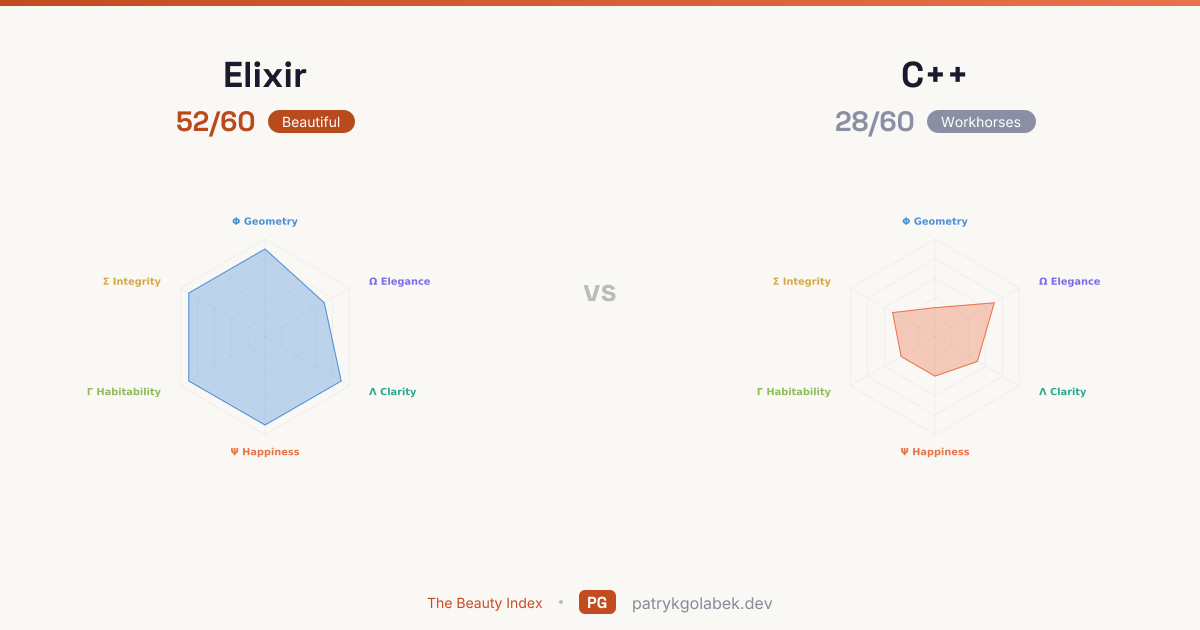
Elixir scores 52/60 against C++'s 28/60, leading in 5 of 6 dimensions. Elixir dominates the aesthetic, human, and design axes. Aesthetic Geometry is where the pair separates most cleanly — Elixir leads C++ by 6 points and that gap colours everything else on the page.
See also: Elixir vs Python , Elixir .
Dimension-by-dimension analysis
Φ Aesthetic Geometry
Elixir wins Aesthetic Geometry by 6 points — a meaningful cleanliness gap. Pipeline operators, pattern-matching clauses, and module structure create a visual flow that scans beautifully. Elixir code looks like a series of clean, evenly weighted transformation steps. The difference is not cosmetic: Elixir rewards the eye, while C++ asks the reader to absorb more punctuation and more ceremony. Template metaprogramming, #include chains, and nested angle brackets (std::vector<std::pair<int, std::string>>) create some of the most visually dense code in any language. Modern C++ is cleaner, but the language's visual floor is very low. In a language where expressiveness is the selling point, visual calm amplifies the advantage.
Γ Organic Habitability
Elixir wins Organic Habitability by 5 points — a real habitability advantage. Pipelines are growth-point idioms, insert a transformation step anywhere without restructuring. OTP's supervision trees are the embodiment of habitable architecture: systems designed to fail gracefully and be extended incrementally. Where Elixir accommodates change gracefully, C++ makes you earn each new direction. Adding a feature to a C++ codebase can require understanding templates, RAII, move semantics, and exception safety simultaneously. The language's complexity makes modification risky. Codebases tend to become more brittle over time as layers of C++ eras accumulate. For application codebases the habitability edge determines whether a project survives its second rewrite.
Ψ Practitioner Happiness
Elixir wins Practitioner Happiness by 5 points — an unmistakable experiential gap. Stack Overflow admiration at 66%. The Phoenix framework, LiveView, and OTP give practitioners a feeling of building something that "just works." The community is small but deeply enthusiastic and welcoming. Elixir has done the harder cultural work: tooling that delights, a community that welcomes, documentation that explains. Respected for power, rarely enjoyed for developer experience. Build systems, header management, cryptic template error messages, and undefined behavior create constant friction. Developers use C++ because nothing else does what it does, not because they prefer it. In application languages the community culture compounds the language advantage.
Λ Linguistic Clarity
Elixir wins Linguistic Clarity by 4 points — a real readability advantage. The pipe operator (|>) turns data transformation into a readable narrative. "hello" |> String.split() |> Enum.map(&String.capitalize/1) reads as a clear sequence of intentions. Among the most literate functional languages. Elixir reads like a well-edited paragraph; C++ reads like a sentence that is still being translated. Modern C++ is more readable than legacy C++, but the language's accumulated complexity means any line might require knowing 10 different features. Range-based for loops and structured bindings help, but the cognitive load of "which C++ era is this?" persists. In high-level work, readable code is the difference between a 6-month onboarding and a 6-week one.
Σ Conceptual Integrity
Elixir wins Conceptual Integrity by 4 points — a genuine lead in design coherence. "Erlang's power with modern syntax." José Valim had a clear vision: bring functional programming and fault-tolerant concurrency to a wider audience. The language feels designed by one mind with a singular purpose. Where Elixir holds a line, C++ has negotiated with history, ecosystems, and legacy users. "C with classes" was a clear idea, but 40+ years of committee additions have layered paradigms without full integration. C++11/14 brought more coherence (RAII, value semantics, move), but the language remains a cathedral built by many architects across many centuries. The winner's philosophical discipline is what keeps its idioms stable as the language evolves.
Ω Mathematical Elegance
Both score 7 — this is one dimension where Elixir and C++ genuinely agree. Pattern matching, recursion, and immutable data structures support elegant algorithm expression. Not as abstract as Haskell or OCaml, but the BEAM VM's concurrency primitives give certain distributed algorithms an inevitable quality. Algorithmically the two meet on equal ground; elegance is not what separates them. C++ is Turing-complete at compile time. Template metaprogramming and concepts (C++20) enable powerful abstractions. The mathematical capability is real, but std::transform(v.begin(), v.end(), v.begin(), [](int x){ return x*x; }) vs. Haskell's map (^2) v tells the story, the machinery is always visible. The winner lets the author think in algorithms rather than in ceremony.
Code comparison
Exception handling via try/catch or Result/Either patterns.
with {:ok, user} <- fetch_user(id), {:ok, posts} <- fetch_posts(user.id), {:ok, _} <- validate(posts) do {:ok, format_response(user, posts)}else {:error, :not_found} -> {:error, "User not found"} {:error, reason} -> {:error, reason}end#include <stdexcept>
int parseNumber(const std::string& s) { try { return std::stoi(s); } catch (const std::invalid_argument& e) { throw std::runtime_error("Invalid: " + s); }}
try { auto result = parseNumber("42");} catch (const std::exception& e) { std::cerr << e.what() << "\n";}The characteristic code snippet that best represents each language.
def process_order(%Order{items: items, user: user}) do items |> Enum.filter(&(&1.in_stock)) |> Enum.map(&apply_discount(&1, user.tier)) |> Enum.reduce(0, &(&1.price + &2)) |> apply_tax(user.region) |> format_total()endclass ResourcePool { std::vector<std::unique_ptr<Connection>> pool_;public: auto acquire() { if (pool_.empty()) pool_.push_back(std::make_unique<Connection>()); auto conn = std::move(pool_.back()); pool_.pop_back(); return std::shared_ptr<Connection>( conn.release(), [this](Connection* c) { pool_.emplace_back(c); } ); }};Map, filter, reduce and functional collection transformations.
numbers = 1..10
doubled = Enum.map(numbers, &(&1 * 2))evens   = Enum.filter(numbers, &(rem(&1, 2) == 0))total   = Enum.reduce(numbers, 0, &+/2)
result = numbers|> Enum.filter(&(rem(&1, 2) == 0))|> Enum.map(&(&1 * &1))auto numbers = std::views::iota(1, 11) | std::ranges::to<std::vector>();
auto doubled = numbers | std::views::transform([](int n) { return n * 2; });auto evens = numbers | std::views::filter([](int n) { return n % 2 == 0; });auto total = std::accumulate(numbers.begin(), numbers.end(), 0);Frequently asked questions
- Which is easier to learn, Elixir or C++?
- Elixir scores 9 on Practitioner Happiness versus C++'s 4. Stack Overflow admiration at 66%. The Phoenix framework, LiveView, and OTP give practitioners a feeling of building something that "just works." The community is small but deeply enthusiastic and welcoming. For classroom or self-directed study, the practitioner-happiness winner almost always has better learning materials and kinder error messages.
- Is Elixir or C++ better for visually clean syntax?
- For visually clean syntax, Elixir has a clear edge — it scores 9/10 on Aesthetic Geometry against C++'s 3/10. Pipeline operators, pattern-matching clauses, and module structure create a visual flow that scans beautifully. Elixir code looks like a series of clean, evenly weighted transformation steps.
- Should I pick Elixir or C++ in 2026?
- Elixir lands in the beautiful tier at 52/60; C++ in the workhorses tier at 28/60. With this much daylight between them, the higher scorer is the default and the lower scorer needs a business case. The score difference reflects years of community use, tooling maturity, and the editorial judgment of the Beauty Index rubric.