
Dart vs F#
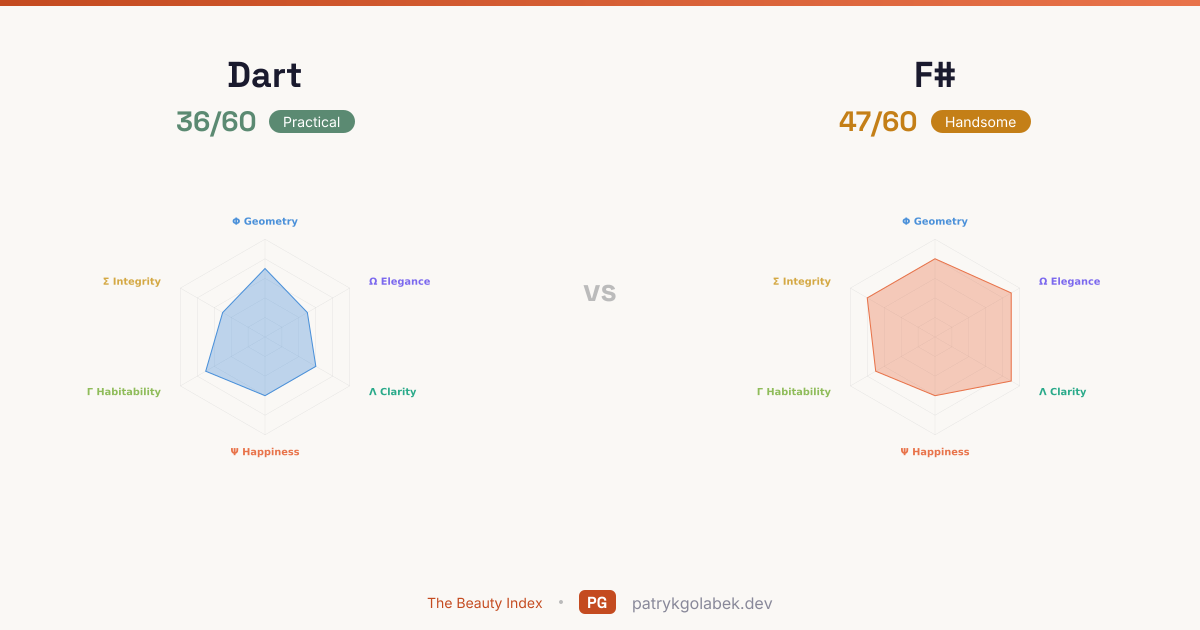
Dart
The second-chance kid who found their calling in Flutter. Dart was nearly forgotten until mobile development gave it a purpose, and now it's living its best life painting pixels.
F#
The brilliant cousin nobody invites to parties. F# does everything right on the .NET platform, writes more elegant code than C# ever could, and wonders why nobody's paying attention.
F# scores 47/60 against Dart's 36/60, leading in 4 of 6 dimensions. F# dominates the aesthetic, mathematical, and design axes. The widest gap sits on Mathematical Elegance, where F#'s 4-point lead over Dart shapes most of the pair's character.
See also: Dart vs C# , Dart .
Dimension-by-dimension analysis
Ω Mathematical Elegance
F# wins Mathematical Elegance by 4 points — a genuine expressive lead. MetaLanguage-family heritage gives F# deep mathematical roots. Computation expressions, active patterns, and type providers enable algorithm expression that approaches Hardy's "economy" criterion. The gap on Elegance is real: F# rewards precise thought, Dart rewards precise bookkeeping. Dart is a pragmatic language without strong mathematical abstractions. It does what it needs to for UI programming. Generics and async/await are useful but not mathematically elegant. For high-level work, the gap compounds: fewer lines per algorithm means fewer bugs per feature.
Λ Linguistic Clarity
F# wins Linguistic Clarity by 3 points — a clear signal-to-noise edge. The pipeline operator, discriminated unions, and lack of ceremony make F# remarkably readable. items |> List.filter isValid |> List.map transform reads as a clear chain of intent. One of the most literate typed languages. Where F# favours plain intent, Dart trades clarity for control, capability, or history. Readable and predictable. Named parameters, cascade notation (..), and clear class syntax make intent visible. Not particularly literary, but consistently clear. The winner here treats readability as a core feature rather than a style preference.
Σ Conceptual Integrity
F# wins Conceptual Integrity by 3 points — a clear integrity advantage. "Functional-first on .NET" is a clear, focused vision that Don Syme has maintained consistently. F# knows what it is and doesn't try to be everything. The design is opinionated in the right ways. Where F# holds a line, Dart has negotiated with history, ecosystems, and legacy users. Dart's identity crisis, initially a web language, then reborn as a Flutter companion, weakens its conceptual integrity. It's a good language in service of a framework, not a language with its own philosophical center. The winner's philosophical discipline is what keeps its idioms stable as the language evolves.
Φ Aesthetic Geometry
F# edges Dart by a single point on Aesthetic Geometry; the practical difference is slim but real. Significant whitespace, pipeline operators, and concise type definitions give F# a clean, proportional visual feel. Pattern matching arms align naturally. Less visual noise than C# by a wide margin. Both Dart and F# care about how code looks — they simply draw the line in slightly different places. Dart's syntax is clean and visually familiar to Java/JavaScript developers. Flutter's widget tree syntax, with its trailing commas and nested constructors, has a structured, tree-like visual geometry. Designers of high-level code feel this difference the moment they open an unfamiliar module.
Γ Organic Habitability
Both score 7 — this is one dimension where Dart and F# genuinely agree. Dart codebases grow well within the Flutter paradigm. The widget composition model encourages incremental, modular extension. Sound null safety (added retroactively) improved long-term maintainability. On habitability the outcome is even; what tips the scale is elsewhere. Type inference and immutability-by-default produce code that ages reasonably well. The .NET interop story is good. Docked because the ecosystem's size means patterns and libraries are less battle-tested than in larger communities. The winner here is the language you will still enjoy reading in five years.
Ψ Practitioner Happiness
Both score 6 — this is one dimension where Dart and F# genuinely agree. Flutter developers generally enjoy the experience. Hot reload is a genuine joy. The language itself is pleasant enough, but Dart's identity is inseparable from Flutter, outside that context, enthusiasm drops significantly. Both communities love their language with equal fervour; this is the one dimension where Dart and F# genuinely agree. A small, devoted community, but limited industry adoption creates friction, fewer libraries, fewer tutorials, fewer jobs. The .NET ecosystem helps, but F# often feels like a second-class citizen behind C#. For high-level work, developer happiness is the main driver of long-term retention.
Code comparison
Data structure definition using classes, structs, records, or equivalent.
class User {  final String name;  final String email;  final int age;
  const User({    required this.name,    required this.email,    this.age = 0,  });
String greeting() => 'Hello, $name!';}type User = { Name: string Email: string Age: int } member this.Greeting = sprintf "Hello, %s!" this.Name
let user = { Name = "Alice"; Email = "a@b.c"; Age = 30 }let updated = { user with Age = 31 }Exception handling via try/catch or Result/Either patterns.
int parseNumber(String s) {  try {    return int.parse(s);  } on FormatException catch (e) {    throw ArgumentError('Invalid: $s');  }}
try { final result = parseNumber('42'); print(result);} catch (e) { print('Error: $e');}let safeDivide a b = if b = 0.0 then Error "Division by zero" else Ok (a / b)
let compute = safeDivide 10.0 2.0 |> Result.bind (fun x -> safeDivide x 3.0) |> Result.map (fun y -> y + 1.0)
match compute with| Ok v -> printfn "Got: %f" v| Error e -> printfn "Error: %s" eNative pattern matching constructs for destructuring and control flow.
String describe(Object obj) => switch (obj) { int n when n > 0 => 'positive: $n', String s => 'string: $s', (int x, int y) => 'point: $x, $y', _ => 'unknown',};let describe = function | [] -> "empty" | [x] -> sprintf "singleton: %A" x | x :: _ when x > 0 -> "starts positive" | _ -> "other"
let area = function | Circle r -> System.Math.PI * r * r | Rect (w, h) -> w * hFrequently asked questions
- Which is easier to learn, Dart or F#?
- Dart and F# are tied on Practitioner Happiness at 6/10 — both are broadly welcoming to newcomers. Flutter developers generally enjoy the experience. Hot reload is a genuine joy. The language itself is pleasant enough, but Dart's identity is inseparable from Flutter, outside that context, enthusiasm drops significantly. When ease of learning is the deciding factor, the happier community wins every time — mentors, docs, and examples are simply more abundant.
- Is Dart or F# better for algorithm-heavy code?
- For algorithm-heavy code, F# has a clear edge — it scores 9/10 on Mathematical Elegance against Dart's 5/10. MetaLanguage-family heritage gives F# deep mathematical roots. Computation expressions, active patterns, and type providers enable algorithm expression that approaches Hardy's "economy" criterion.
- Should I pick Dart or F# in 2026?
- Dart lands in the practical tier at 36/60; F# in the handsome tier at 47/60. The gap is wide. Unless a specific platform or ecosystem constraint forces the other choice, go with the higher-scoring language. The score difference reflects years of community use, tooling maturity, and the editorial judgment of the Beauty Index rubric.