
C# vs Elixir
C#
The corporate executive who secretly writes poetry. C# started as a Java clone in a suit, then quietly evolved into one of the most feature-complete languages ever designed.
Elixir
The jazz musician who studied classical. Elixir takes Erlang's battle-tested concurrency and wraps it in syntax so pleasant you forget you're building distributed systems that never go down.
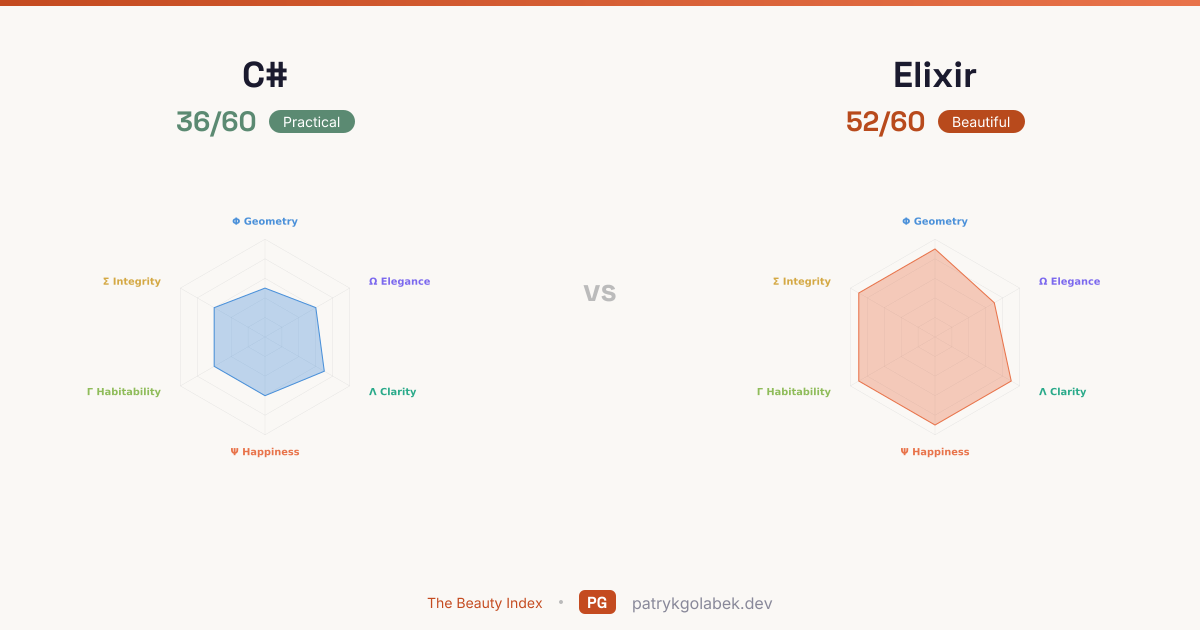
Elixir scores 52/60 against C#'s 36/60, leading in 6 of 6 dimensions. Elixir dominates the aesthetic, mathematical, human, and design axes. Aesthetic Geometry is where the pair separates most cleanly — Elixir leads C# by 4 points and that gap colours everything else on the page.
See also: C# vs Dart , C# .
Dimension-by-dimension analysis
Φ Aesthetic Geometry
Elixir wins Aesthetic Geometry by 4 points — a decisive visual advantage. Pipeline operators, pattern-matching clauses, and module structure create a visual flow that scans beautifully. Elixir code looks like a series of clean, evenly weighted transformation steps. The visual gap between the two is not subtle — where Elixir prizes geometric calm, C# trades that serenity for other commitments. C# has reduced ceremony significantly with top-level statements, records, and file-scoped namespaces. But the language's Java-era heritage still shows in verbose patterns, property accessors, attribute decorations, and using blocks add visual weight. Improving, but not yet clean. In a language where expressiveness is the selling point, visual calm amplifies the advantage.
Γ Organic Habitability
Elixir wins Organic Habitability by 3 points — a meaningful extensibility gap. Pipelines are growth-point idioms, insert a transformation step anywhere without restructuring. OTP's supervision trees are the embodiment of habitable architecture: systems designed to fail gracefully and be extended incrementally. Elixir invites modification; C# rewards planning more than adjustment. C#'s backward compatibility and incremental feature additions mean codebases can adopt new patterns gradually. The ecosystem is mature and battle-tested. Docked because the language's breadth (OOP + FP + async + LINQ + dynamic) means codebases vary widely in style. In high-level work, the language that welcomes modification wins the decade, not the quarter.
Ψ Practitioner Happiness
Elixir wins Practitioner Happiness by 3 points — a real happiness advantage. Stack Overflow admiration at 66%. The Phoenix framework, LiveView, and OTP give practitioners a feeling of building something that "just works." The community is small but deeply enthusiastic and welcoming. Elixir has done the harder cultural work: tooling that delights, a community that welcomes, documentation that explains. Modern .NET is a pleasure to use, excellent tooling (Rider, VS Code, hot reload), rapid language evolution, and an engaged community. Stack Overflow admiration is solid and improving. The "corporate Java clone" reputation is outdated but sticky, and the developer experience has genuinely earned a higher mark than the old perception suggests. The winner here invites the next generation of contributors without asking them to earn it first.
Σ Conceptual Integrity
Elixir wins Conceptual Integrity by 3 points — a decisive philosophical edge. "Erlang's power with modern syntax." José Valim had a clear vision: bring functional programming and fault-tolerant concurrency to a wider audience. The language feels designed by one mind with a singular purpose. The design philosophy of Elixir feels inevitable, each feature a consequence of one idea — C# feels assembled from several good ideas instead of from one great one. Anders Hejlsberg has maintained a clearer vision than most credit, async/await, LINQ, and pattern matching feel designed rather than patched on. But the steady feature accumulation over 25 years does dilute the singular "language soul." C# is coherent, not focused. For application code the integrity edge means fewer "wait, why does it behave that way?" moments per week.
Λ Linguistic Clarity
Elixir wins Linguistic Clarity by 2 points — a meaningful clarity gap. The pipe operator (|>) turns data transformation into a readable narrative. "hello" |> String.split() |> Enum.map(&String.capitalize/1) reads as a clear sequence of intentions. Among the most literate functional languages. Where Elixir favours plain intent, C# trades clarity for control, capability, or history. Modern C# reads well, async/await patterns are clear, LINQ chains communicate intent, and named arguments help. The language has steadily improved its Knuthian "wit" with each version. In high-level work, readable code is the difference between a 6-month onboarding and a 6-week one.
Ω Mathematical Elegance
Elixir edges C# by a single point on Mathematical Elegance; the practical difference is slim but real. Pattern matching, recursion, and immutable data structures support elegant algorithm expression. Not as abstract as Haskell or OCaml, but the BEAM VM's concurrency primitives give certain distributed algorithms an inevitable quality. The elegance gap is narrow enough that idiomatic style often matters more than the language itself. LINQ is genuinely elegant, embedding query algebra into the type system is a real achievement. Pattern matching in C# 11+ is increasingly expressive. But the OOP substrate limits how close algorithms can get to mathematical notation. For high-level work, the gap compounds: fewer lines per algorithm means fewer bugs per feature.
Code comparison
Exception handling via try/catch or Result/Either patterns.
try{ var result = int.Parse(input); Console.WriteLine(result * 2);}catch (FormatException e) when (e.Message.Contains("Input")){ Console.WriteLine($"Invalid: {e.Message}");}catch (Exception e){ Console.WriteLine($"Error: {e.Message}");}finally { Cleanup(); }with {:ok, user} <- fetch_user(id), {:ok, posts} <- fetch_posts(user.id), {:ok, _} <- validate(posts) do {:ok, format_response(user, posts)}else {:error, :not_found} -> {:error, "User not found"} {:error, reason} -> {:error, reason}endFunction definition, parameters, return types, and closures.
string Greet(string name) => $"Hello, {name}!";
T Apply<T>(Func<T, T> f, T x) => f(x);
Func<int, int> doubler = x => x * 2;var sum = numbers.Aggregate(0, (acc, n) => acc + n);def greet(name) do "Hello, #{name}!"end
def validate(input) when is_binary(input) do {:ok, input}end
square = fn x -> x * x endapply = &(&1 + &2)Native pattern matching constructs for destructuring and control flow.
string Describe(object obj) => obj switch{ int n when n > 0 => $"positive: {n}", string s => $"string: {s}", (int x, int y) => $"point: {x},{y}", null => "null", _ => "unknown"};case list do [] -> "empty" [x] -> "just #{x}" [h | _] when h > 0 -> "starts positive" _ -> "other"end
# Function clause pattern matching (inside a module)# def handle({:ok, result}), do: result# def handle({:error, reason}), do: raise reason
{:ok, value} = {:ok, 42}Frequently asked questions
- Which is easier to learn, C# or Elixir?
- Elixir scores 9 on Practitioner Happiness versus C#'s 6. Stack Overflow admiration at 66%. The Phoenix framework, LiveView, and OTP give practitioners a feeling of building something that "just works." The community is small but deeply enthusiastic and welcoming. For a developer adding a new language to their toolbelt, the happier one is the one you will still be writing in six months.
- Is C# or Elixir better for visually clean syntax?
- For visually clean syntax, Elixir has a clear edge — it scores 9/10 on Aesthetic Geometry against C#'s 5/10. Pipeline operators, pattern-matching clauses, and module structure create a visual flow that scans beautifully. Elixir code looks like a series of clean, evenly weighted transformation steps.
- Should I pick C# or Elixir in 2026?
- C# lands in the practical tier at 36/60; Elixir in the beautiful tier at 52/60. The gap is wide. Unless a specific platform or ecosystem constraint forces the other choice, go with the higher-scoring language. The score difference reflects years of community use, tooling maturity, and the editorial judgment of the Beauty Index rubric.