
Clojure vs Elixir
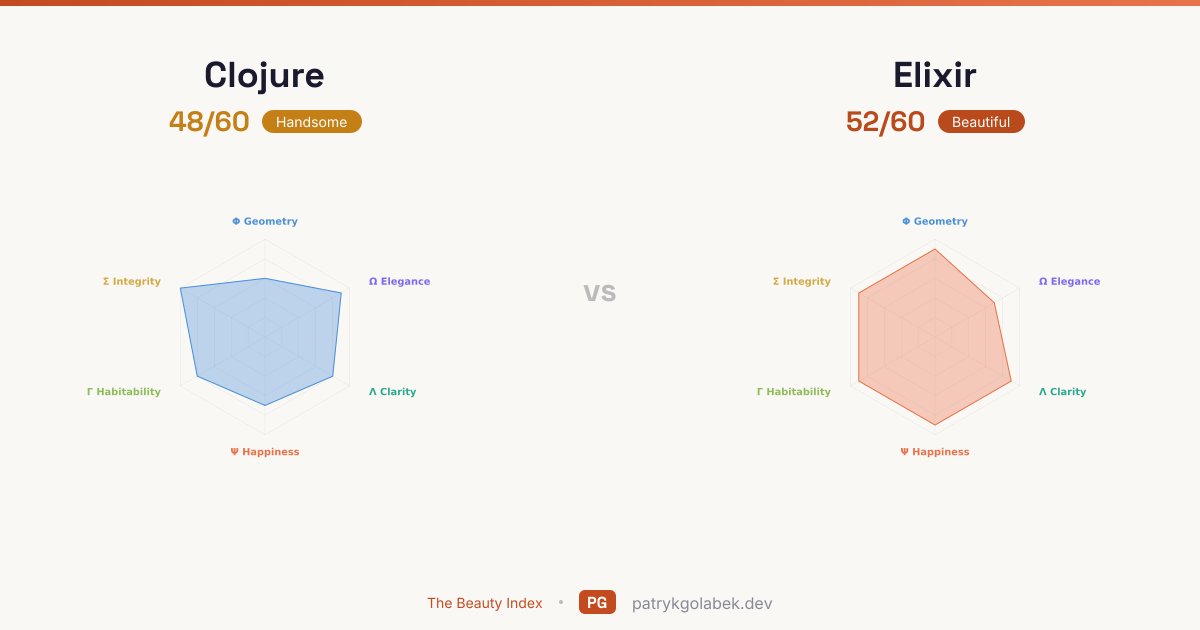
Clojure
The Zen master who sees through your abstractions. Clojure distills programming to data, functions, and immutability, then watches smugly as your mutable-state codebase catches fire.
Elixir
The jazz musician who studied classical. Elixir takes Erlang's battle-tested concurrency and wraps it in syntax so pleasant you forget you're building distributed systems that never go down.
Elixir scores 52/60 against Clojure's 48/60, leading in 4 of 6 dimensions. Clojure owns mathematical and design while Elixir leads in aesthetic and human. The widest gap sits on Aesthetic Geometry, where Elixir's 3-point lead over Clojure shapes most of the pair's character.
See also: PHP vs Elixir , Clojure .
Dimension-by-dimension analysis
Φ Aesthetic Geometry
Elixir wins Aesthetic Geometry by 3 points — a clear geometric edge. Pipeline operators, pattern-matching clauses, and module structure create a visual flow that scans beautifully. Elixir code looks like a series of clean, evenly weighted transformation steps. Clojure, by contrast, accepts visual density in exchange for other priorities. Clojure's parentheses-heavy syntax is unconventional, but it's regular and tree-like. The uniform (verb noun noun) structure has its own geometric coherence once you internalize the visual grammar. Not chaotic, just non-traditional. Designers of high-level code feel this difference the moment they open an unfamiliar module.
Ω Mathematical Elegance
Clojure wins Mathematical Elegance by 2 points — a genuine expressive lead. Homoiconicity (code is data) enables metaprogramming that feels mathematical. Persistent data structures, lazy sequences, and transducers let you express algorithms with remarkable economy. Among the most "Book", like in practice. Where Clojure compresses an idea into a line or two, Elixir tends to spread the same idea across a paragraph. Pattern matching, recursion, and immutable data structures support elegant algorithm expression. Not as abstract as Haskell or OCaml, but the BEAM VM's concurrency primitives give certain distributed algorithms an inevitable quality. The winner lets the author think in algorithms rather than in ceremony.
Ψ Practitioner Happiness
Elixir wins Practitioner Happiness by 2 points — a decisive cultural edge. Stack Overflow admiration at 66%. The Phoenix framework, LiveView, and OTP give practitioners a feeling of building something that "just works." The community is small but deeply enthusiastic and welcoming. Where Elixir feels designed for the human, Clojure feels designed for the machine first — the human catches up second. A devoted, intellectually engaged community. The REPL-driven workflow induces genuine flow states. The ecosystem is mature (for its size). Docked because the community is small and Lisp-family syntax creates a real adoption barrier. The winner here invites the next generation of contributors without asking them to earn it first.
Γ Organic Habitability
Elixir edges Clojure by a single point on Organic Habitability; the practical difference is slim but real. Pipelines are growth-point idioms, insert a transformation step anywhere without restructuring. OTP's supervision trees are the embodiment of habitable architecture: systems designed to fail gracefully and be extended incrementally. On extensibility the two are close enough that the decision rarely hinges on this axis alone. Immutable data and pure functions produce code that is inherently easy to extend and modify, no hidden state to trip over. Rich Hickey's "simple made easy" philosophy is the definition of habitable design. The winner here is the language you will still enjoy reading in five years.
Λ Linguistic Clarity
Elixir edges Clojure by a single point on Linguistic Clarity; the practical difference is slim but real. The pipe operator (|>) turns data transformation into a readable narrative. "hello" |> String.split() |> Enum.map(&String.capitalize/1) reads as a clear sequence of intentions. Among the most literate functional languages. On readability the edge is slim and disappears quickly as idioms are learned. Threading macros (->, ->>) transform nested Lisp into readable pipelines. The data-oriented philosophy, plain maps and vectors over custom types, makes intent transparent. Prefix notation is a barrier for newcomers, but the idioms are clear once learned. For application code the clarity advantage is the whole point of the language category.
Σ Conceptual Integrity
Clojure edges Elixir by a single point on Conceptual Integrity; the practical difference is slim but real. "Code is data. Data is code. Everything is immutable." Clojure is distilled philosophy, every design choice follows from a handful of axioms. Rich Hickey's talks are effectively the language's specification, and the language is the talks made concrete. Both Clojure and Elixir have coherent design philosophies; Clojure merely holds to its centre with a firmer grip. "Erlang's power with modern syntax." José Valim had a clear vision: bring functional programming and fault-tolerant concurrency to a wider audience. The language feels designed by one mind with a singular purpose. In high-level work a coherent philosophy is the frame that holds the language's features together.
Code comparison
Exception handling via try/catch or Result/Either patterns.
(defn parse-number [s]  (try    (Integer/parseInt s)    (catch NumberFormatException _      (throw (ex-info "Invalid input"                      {:input s})))))
(try (parse-number "42") (catch Exception e (println "Error:" (ex-message e))))with {:ok, user} <- fetch_user(id), {:ok, posts} <- fetch_posts(user.id), {:ok, _} <- validate(posts) do {:ok, format_response(user, posts)}else {:error, :not_found} -> {:error, "User not found"} {:error, reason} -> {:error, reason}endBasic variable syntax, type annotations, and initialization patterns.
Native pattern matching constructs for destructuring and control flow.
(require '[clojure.core.match :refer [match]])
(match [x y]  [_ 0] "y is zero"  [0 _] "x is zero"  [a b] (str "both non-zero: " a ", " b))
(let [{:keys [name age]} person] (str name " is " age))case list do [] -> "empty" [x] -> "just #{x}" [h | _] when h > 0 -> "starts positive" _ -> "other"end
# Function clause pattern matching (inside a module)# def handle({:ok, result}), do: result# def handle({:error, reason}), do: raise reason
{:ok, value} = {:ok, 42}Frequently asked questions
- Which is easier to learn, Clojure or Elixir?
- Elixir scores 9 on Practitioner Happiness versus Clojure's 7. Stack Overflow admiration at 66%. The Phoenix framework, LiveView, and OTP give practitioners a feeling of building something that "just works." The community is small but deeply enthusiastic and welcoming. For a newcomer picking up their first serious language in 2026, the happiness-score winner is the more forgiving starting point.
- Is Clojure or Elixir better for visually clean syntax?
- For visually clean syntax, Elixir has a clear edge — it scores 9/10 on Aesthetic Geometry against Clojure's 6/10. Pipeline operators, pattern-matching clauses, and module structure create a visual flow that scans beautifully. Elixir code looks like a series of clean, evenly weighted transformation steps.
- Should I pick Clojure or Elixir in 2026?
- Clojure lands in the handsome tier at 48/60; Elixir in the beautiful tier at 52/60. The score gap is real; the higher-scoring language has a measurable edge. Go the other way only if a concrete ecosystem need pulls you there.